Apr 21, 2021
Looking back on my previous entries, I think I begin all of them with the same idea, namely that it is a busy time here in Loreto Rumbek. Being something of a traditionalist, I’ll continue in that vein, at least for now anyway. Since I wrote last, we have had a number of welcome visitors and one big celebration.
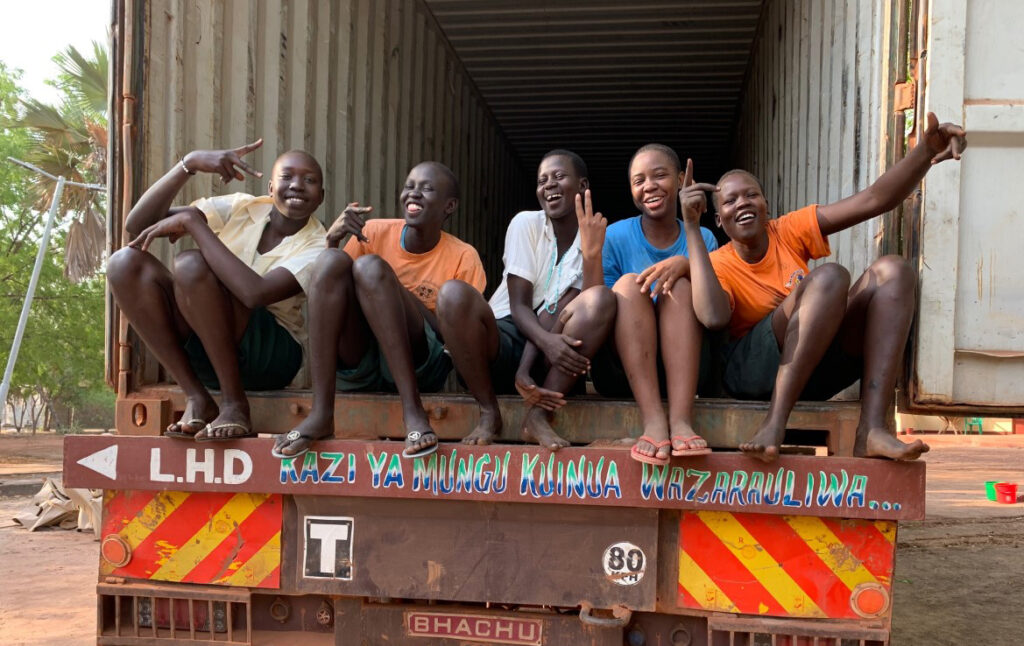
The first arrival was the truck. Once a year a large container lorry trundles northward from Nairobi to the border post of Nadapal between Kenya and South Sudan, before passing through Juba and finally arriving at our school. It is a mammoth journey at the best of times, but with the terrible road conditions, the beginning of the first rains, and persistent insecurity it can be perilous. Its arrival is greeted with great enthusiasm and I think the best description is that it is like Christmas with really sensible, practical presents. The basics that we can pick up in any Dunnes, Spar or Woodies back home are luxuries here. There are really no local shops that can supply the needs of a school, let alone a clinic or an agricultural project. The truck was filled with mundane essentials like school uniforms, tools, desks, two sowing machines, medical equipment, and textbooks. There was also a small fridge for me. The absolute luxury! While I’m writing this in 40C, I’m sipping some ice-cold water. It is like a little corner of Heaven!
Last Wednesday the Governor of Lakes State, along with the local Minister for Education and the Minister for Labour paid our school a visit. They took the time to walk around the compound with Sr. Orla, dropping into the clinic and taking look at our primary school. The clinic is tearing busy, looking after over four thousand patients a month, while the primary school is closed due to Covid restrictions. Thankfully, we received word last night that they will begin to reopen on May 3rd, allowing life to return to some measure of normality. Anyway, back to the Governor and the Ministers. They spoke at length to the students about the importance of education and how they were committed to fighting early forced marriage. How these words will be transformed into action remains to be seen, but even the public commitment itself is a powerful witness for the rights of young women to be allowed to determine their own future.
On Thursday we welcomed Bishop-Elect Fr. Christian Carlassare to Rumbek. Our Diocese has been without a bishop for almost ten years and his arrival was greeted with wonderful enthusiasm. He is originally from Italy, but has lived and ministered in South Sudan since 2005. As the only two schools currently open in the state, the students from Loreto joined the boys from La Salle Catholic Secondary School to provide a guard of honour. In his opening speech he shared his vision for the future drawing on Galatians Chapter 3 to have a community of faith unified in the love of Jesus. He dropped by the school yesterday to say thank you to the students and to meet the team here. There will be exciting times ahead. Please do keep him in your prayers.
In addition to all the arrivals, we also had to celebrate a birthday. Loreto Secondary School officially became a teenager last Tuesday, celebrating thirteen years educating the girls in Rumbek. To mark the occasion Sr. Orla, the director, and Mrs. Njuguna, the principal of the school, turned a sod for a new grotto for Our Lady. We had a simple prayer service with all the students, teachers, and support staff, followed by a celebration of music and dance in the dining hall. Considering its humble beginnings, it is a truly remarkable achievement. We have gone from a situation where people were predicting no girl would want to attend the school when it opened to today, where we had an entrance exam for ten places in Senior 2 and Senior 3 and over 160 applicants turned up! It has been a long road, but people here and those who support the school have kept the faith.
We are beginning end of term holidays this coming Friday, so many of the girls and staff will be heading home. We will have around sixty students staying with us, because they come from far away or they are at risk of an enforced marriage. It should be a quieter, gentler couple of weeks. After all they busyness, it will be welcome.
Ben Nhialic areer keg a way,
Fr. Alan.
Read more of Fr Alan’s journey:
– Looking for a Sign on the Way to South Sudan
– Building a Better Future in South Sudan
– Chirstmas greetings from Fr Alan in South Sudan
– A Cup of Sugar and Maybe a Goat
– Mock Exams and Real Life in South Sudan
– As Easy as Baking a Cake
– Holy Week on the Move
HELP US TO TRANSFORM LIVES IN SOUTH SUDAN
Apr 8, 2021
It’s a busy time here in Loreto Rumbek. I have just arrived back from leave and we are straight into Holy Week. As we are a boarding school, we have been able to maintain a rigorous lockdown and this has allowed us to celebrate the Easter Triduum. What a gift! When I was back in Ireland at the beginning of March, I had not realised the inability to join my parish would have affected me as much, but it did. There is something in the coming together; the meeting of old friends and new; and the raising hearts and minds to God as a community of faith that is an integral part of who we are as Catholics. It’s something I don’t think I’ll take for granted again.
Well now I’m back and we’re moving. It’s not just Holy Week that has me running around the place. Our final year students are sitting their Leaving Cert as I write this. It would normally happen earlier in the year, but understandably everything has been thrown up in the air. Each day I pass by the hall to wish them well. As I have explained before, there is a lot riding on the results of these exams. In fact, their outcome will determine the students’ future for themselves and their family. If they can do well and maybe even get a scholarship to university, they could raise an entire family out of poverty, while securing a better future for themselves. Simply put these two weeks will make all the difference in the world. Please do keep them in your prayers.
As the final year girls finish their exams, they begin their journey home, leaving Loreto for the last time as students. We saw a number of them off during the week with plenty of songs of joy and more than a few tears. God willing, they will return to the school when the results are published, but this time they will do so as graduates. Some will take part in the school’s intern programme. Here they work in the various departments for a two-year commitment, including translating for the patients in our clinic, acting as a teacher’s aid in primary school, helping with logistics, supporting the development programme, and working in the secondary school. Once they have completed their time, we fund their university course entirely. Many who are considering a future in teaching, nursing, or business get wonderful hands on training in the field. The intern programme has been a great success to date. It gives people an opportunity to study at third level that would never have been possible before.
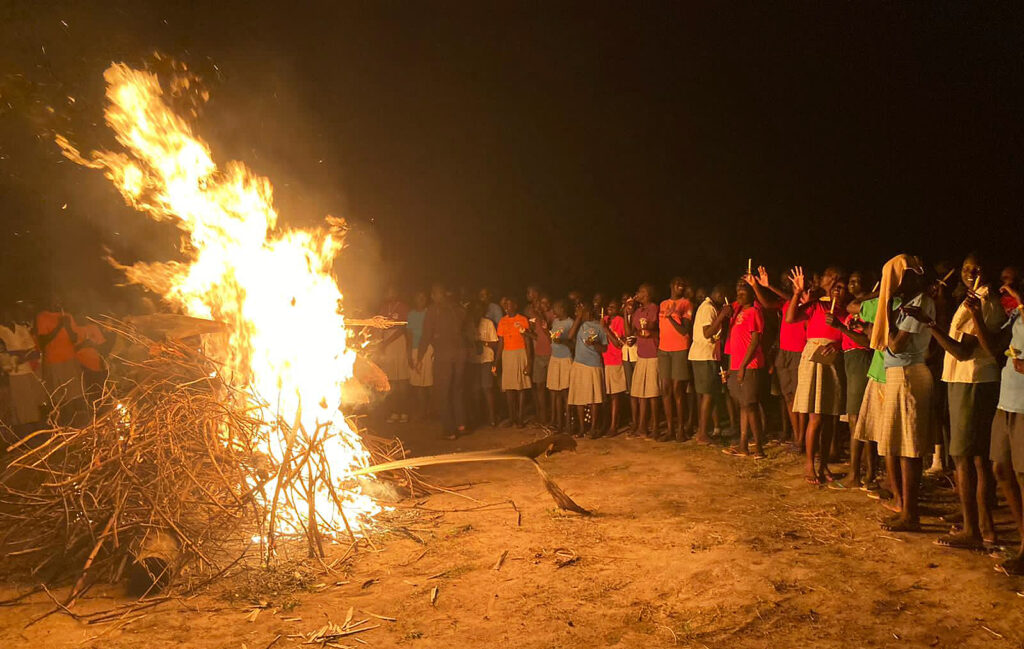
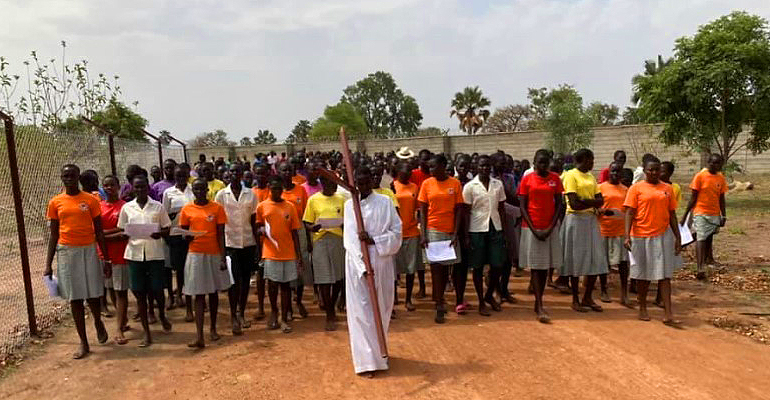
Our celebrations for Holy Week were especially beautiful. On Holy Thursday for the Mass of the Last Supper we had the washing of the feet, with our builders, cooks, nurses, staff, students, and interns acting as the apostles. Good Friday was suitably quiet and reflective. The girls led the Stations of the Cross in the morning across the compound, finishing up at a large, simple metal cross we have by the clinic. In the afternoon we were well up towards 40C, but we still had the Passion and adoration of the Cross. On Holy Saturday our students spent a time of quiet prayer, waiting at the tomb of Jesus. Finally, for our Easter Vigil we began with a truly spectacular bonfire for the blessing of our Paschal candle. Then, under a perfectly clear African night, we processed by candlelight to begin our Mass. It was joyous, with all the readings, hymns, and rich liturgical symbolism. This time of Resurrection marks a new beginning, as we commit ourselves to be an Easter people of hope and joy. Alleluia is our song!
Happy Easter or as they say around here Miet puou jot rot Yesu Kristo,
Fr. Alan
Read more of Fr Alan’s journey:
– Looking for a Sign on the Way to South Sudan
– Building a Better Future in South Sudan
– Chirstmas greetings from Fr Alan in South Sudan
– A Cup of Sugar and Maybe a Goat
– Mock Exams and Real Life in South Sudan
– As Easy as Baking a Cake
HELP US TO TRANSFORM LIVES IN SOUTH SUDAN
Feb 9, 2021
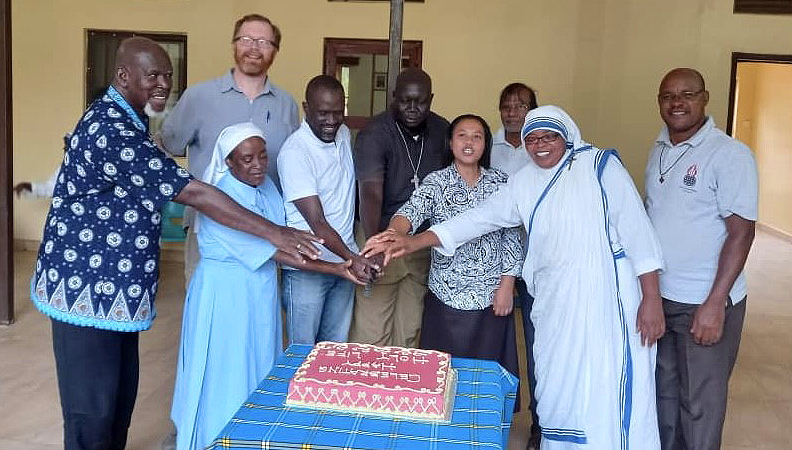
The biggest dilemma at the start of the month was figuring how to fit the words ‘Celebrating Religious Life’ across a cake. It was for the second of February, the World Day of Prayer for Consecrated Life, when the Church acknowledges in a special the contribution of sisters, brothers, and religious priests in the building up of the Kingdom of God.
In the Diocese of Rumbek, we are a broad church with missionaries from around the world working alongside local diocesan clergy and our lay teams. There are sisters from the Missionaries of Charity and the Evangelising Sisters in Cathedral parish, as well as our own Loreto Sisters, along with the brothers from De La Salle community just up the road in their new school for boys. You also have the Jesuits, the Spiritans, and of course one Missionary of the Sacred Heart who wandered in a few months ago and everyone has been too polite to ask what he is actually doing there in the first place.
In all we have over thirty religious sisters, brothers and priests from all across Africa, Asia, Australia and Europe. The ministry that they are involved in includes the usual schools and clinics that are usual in name only. The issues they face and the challenges they meet are well outside the norm of what we typically deal with in the West. This morning the Missionaries of Charity are going to a leper colony an hour outside of town. The Jesuits are setting up an English language course for their adult education programme and are trying to encourage as many women as possible to enrol to improve their future employment prospects. The Loreto sisters and the team in our clinic are getting ready for a possible surge in Covid cases, even though we have no testing kits and there are only four ventilators in the whole country of 11 million people. None are in Rumbek.
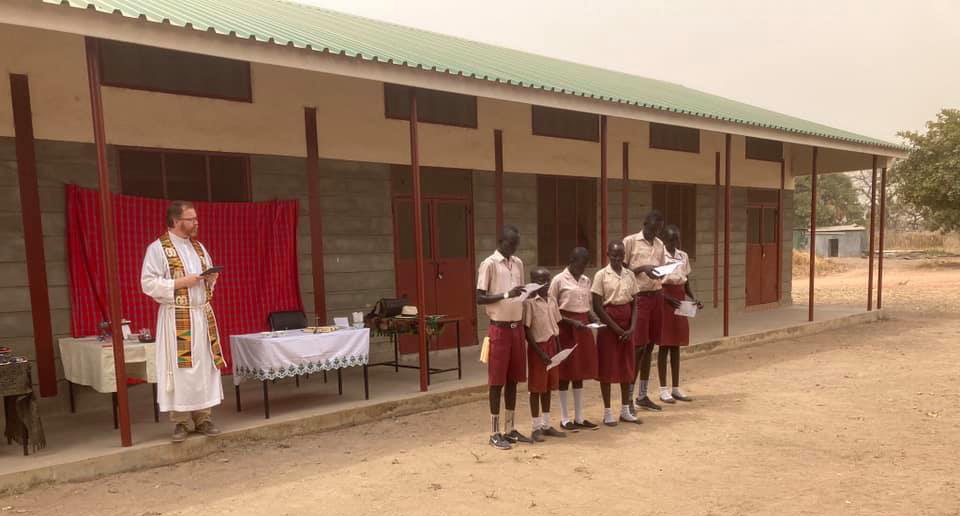
As for myself, I’m still working away on the local language. We had our first Children’s Liturgy last Sunday morning and when I enthusiastically greeted the kids in Dinka there was stony silence. Not a single word. Nothing. Then when one of the students said 100% exactly what I said they were beside themselves with excitement. When I said it again, I got nothing! Afterwards the student said I was doing well, but politely recommended that my accent needs a bit of work. I suspect she is going to be an excellent, if somewhat demanding, teacher one day!
Last Friday we had another wonderful celebration. The children from Year 8 graduated from Loreto Primary School and this very week they will sit the national exams. They are another group you will need to add to your prayers. Seventy-two boys and girls successfully completed their studies. When I spoke with them during Mass, they talked about how their first lessons took place under a large tree in junior infants. It has been a long road and a tumultuous few years, but they persevered. Despite the school’s best efforts many students dropped out along the way due early enforced marriage or the need to go and work to support their family. Still the number of those who persevere continues to grow and education is increasingly seen as the key pathway out of poverty to a better life.
At the graduation Sr. Orla, the Director of Loreto, and Mr. Yuga, the Compound Manager, presented the children with some stationery supplies for their exams and a Bible. In the homily of the Mass, I explained that in life they could go anywhere and do anything as long as they remembered that their education was their passport and their Bible was their guide for the journey. It was day of real thanksgiving for all that was achieved and touched by sorrow as the students will now go on to different schools.
We hope that most of the girls will continue into Senior 1 in Loreto Secondary School. Many of the boys will join the De la Salle Brothers in their school or go to the Comboni school in town run by the Evangelising Sisters and the Diocese. Education is a foundational ministry and one of a number that the sisters, brothers, and priests carry out. As for the cake, well the decorator ran out of space and decided that Celebrating Holy Life was grand. On reflection we all agreed.
“Ben Nhialic areer keg a way!”,
Fr. Alan
Read more of Fr Alan’s journey:
– Looking for a Sign on the Way to South Sudan
– Building a Better Future in South Sudan
– Chirstmas greetings from Fr Alan in South Sudan
– A Cup of Sugar and Maybe a Goat
Images via Fr Alan & Loreto Rumbeck on Facebook
HELP US TO TRANSFORM LIVES IN SOUTH SUDAN
Feb 1, 2021
Life is filled with key moments that help shape us into the person we are today. Many are unique to our story and depend on our different circumstances, but some are shared and have become part of our culture. I would argue that in Ireland one of the biggest, most profoundly impactful events we have is the Leaving Cert. Even mentioning the words brings back memories of feverish late night study, wild prayers for inspiration, and the occasion desperate gamble on what part of each subject you choose to focus your time on.
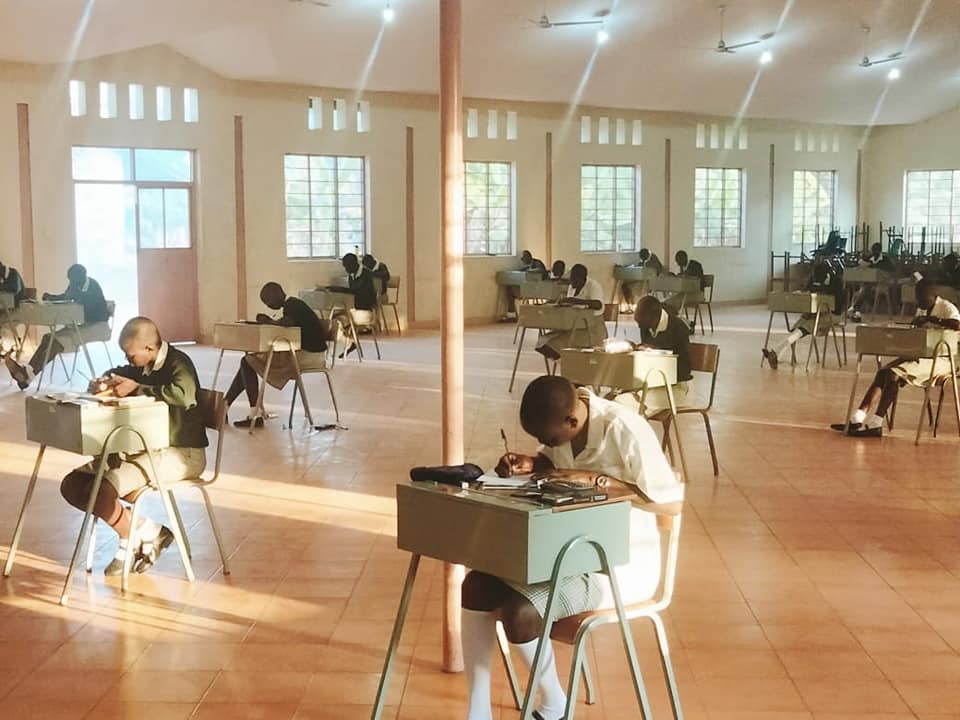
Last week, Loreto Rumbek held the South Sudanese version of the mock Leaving Cert. Students had a week and a half of tests on English, maths, the sciences, geography, history, religious education, and business. Each day I would drop by the exam hall to see how they were doing, give a word of encouragement where needed, and say a prayer for them all. That said, I wouldn’t swap places with them for all the tea in China!
The importance of studies cannot be overemphasised. The girls have made real sacrifices to be here, going against societal expectations and cultural pressures. It is still an unfortunate reality that teenage girls here are more likely to die in childbirth than they are to graduate secondary school. Let that sink in for a second. It sounds unbelievable, but it is true. It gives you an idea of what these girls are fighting for – a better future for themselves and for future generations of young women in South Sudan. The change that needs to happen begins in earnest in that large, dusty exam hall in a place you would struggle to find on a map.
My part in this societal and cultural revolution is tiny, but enthusiastically carried out. The Religious Education teacher finished in the school at the end of 2020, so I naively volunteered to correct and give feedback on the exam papers. I have always been told it is good to help out where you can. In my middle age what I had forgotten was that mocks are always traditionally marked a lot harder than normal. The idea is that it highlights what the students need to focus on and encourages them to study more before the real exams. I was lucky to get out alive after the feedback class. The girls fought and argued for every percentage point, disputing the finer questions of theology, sociology, and moral philosophy with the wit and wisdom of a St. Thomas Aquinas or a St. Catherine of Siena. Here exams really count!
Life has now returned to normal, at least for the time being. In a normal school year, the students would sit their state exams in December. Of course, last year was anything but normal. Now we hope that they will be held in March, but we are still waiting for confirmation. As it stands only exams classes are allowed back in school, but there are signs of a gradual return to education. Most of the children will have been out of class for a year and in a country with no national power grid, let alone internet and computers, home schooling was never an option. So, it’s a new beginning and it will take time, but we will get there. In the meantime, do keep the girls in your prayers. There is a lot riding on how well they do.
God bless or as they say here Ben Nhialic areer keg a way,
Fr. Alan
Read more of Fr Alan’s journey:
– Looking for a Sign on the Way to South Sudan
– Building a Better Future in South Sudan
Images via Loreto Rumbeck on Facebook
HELP US TO TRANSFORM LIVES IN SOUTH SUDAN
Jan 25, 2021
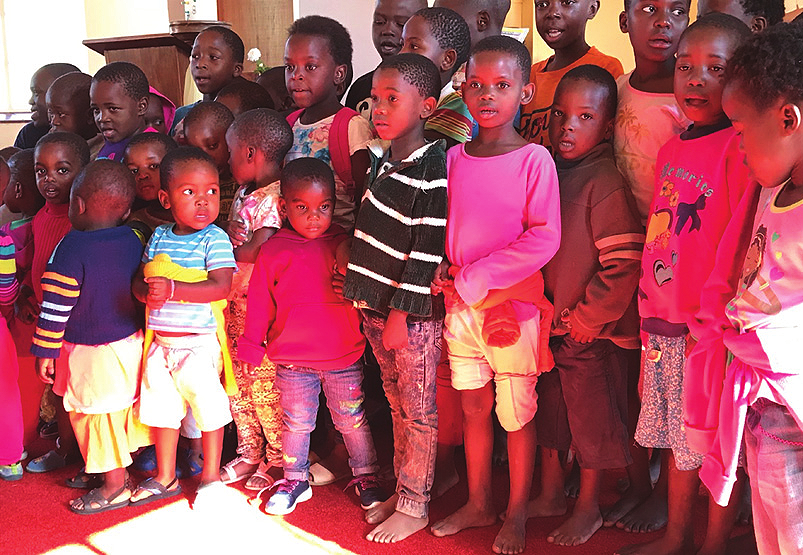
Founded in 2002, the Holy Family Care Centre in South Africa has been run by the Daughters of Our Lady of the Sacred Heart with the support of the MSC for almost 20 years, under the leadership of Sr Sally Duigan FDNSC.
The Holy Family facility provides invaluable care to young children who are seriously ill, and who, in the majority of cases, have been orphaned or abandoned. These children are primarily HIV positive and are in need of specialised care.
“The reasons for admission to the Holy Family Centre vary, but many children have been abandoned, sexually abused, physically abused, orphaned,or made vulnerable because of HIV/AIDS,” says Sr Sally. “Some come from horrific backgrounds and arrive here very ill, malnourished, frightened, lacking social skills, and generally very bewildered.”
The Holy Family Care Centre is, above all, a place of family, unity, and love.
“We love these children unconditionally,” says Sr Sally. “It doesn’t take long for them to feel at home and to change once they feel loved and cared for.”
With the resources to accommodate 70 children, the centre’s facilities are stretched to full capacity and beyond on a daily basis. Today, 76 children are resident at the centre, and of this number, 56 children attend the local primary school.
Last year, due to the challenges brought about by COVID-19, Sr Sally and the Holy Family team made the decision to home school the children for the year.This has proven to be very beneficial for the students, particularly those children with special needs who require extra care and attention.
Now that the school is returning for the new year, the Holy Family children are in need of help. The students need uniforms, shoes, books, pens, pencils,and bags, to prepare for their return to school and to be able to receive an education that will give them a solid foundation for a brighter, more hopeful future.
From pens and pencils to full school uniforms, even a small donation will make a big difference to Sr Sally and the Holy Family team.
Can you help to educate the Holy Family children?
“It is with deep appreciation that I say ‘Thank you!’ In the past year, you have helped our ministries very significantly, and in this time of uncertainty, you are helping us to help people affected by the coronavirus pandemic all over the world.”
“May you be blessed! Be assured of our continued prayers for your intentions, through the intercession of Our Lady of the Sacred Heart.”
Sr Marife Mendoza FDNSC
Congregational Leader of the Daughters of Our Lady of the Sacred Heart
CAN YOU HELP EDUCATE THE HOLY FAMILY CHILDREN?