Jan 14, 2021
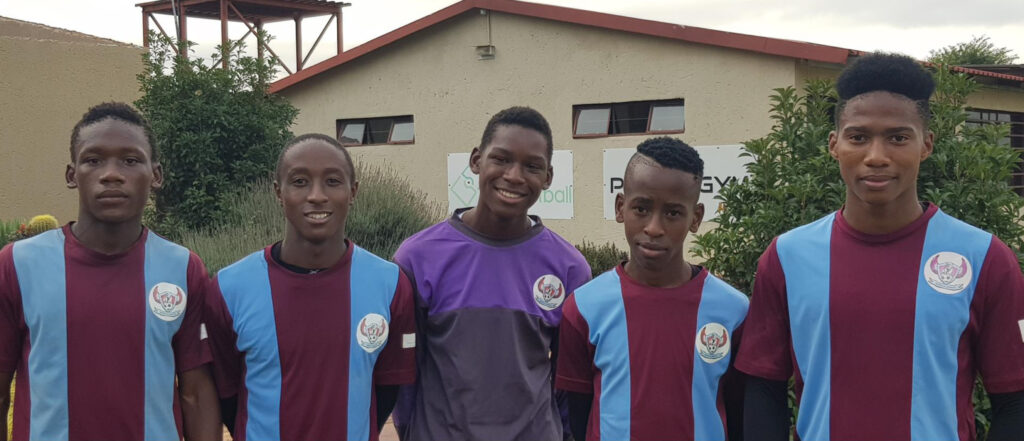
Five academy learners that are greatly benefiting from your extremely generous donation very gratefully received : Koketso Mamogopodi, Lucky Marema, Vokois Mohlabini, Thato Moeti and Litha Lugalo.
Last year as part of our World Missions Appeal you helped us aid the students at Berea-Albion FC & Academy in Pretoria South Africa and we are glad to report the donations have been put to good use. The Academy helps young disadvantaged learners through quality education, accommodation, housing, nutrition, football training and development for a better future life. These youths often have struggled with poverty, HIV/AIDS, abuse, alcoholism, and poor educational backgrounds.
We are pleased to say that since then they have been able to fund the erection of water tanks and buildings which include an eatery/dining area and outdoor meeting and entertainment area for our academy learners.
Neil Bosman, co-founder of the Academy has expressed sincere gratitude for your continued support .
CAN YOU HELP OUR MSC MISSIONS IN SOUTH AFRICA?
Jan 7, 2021
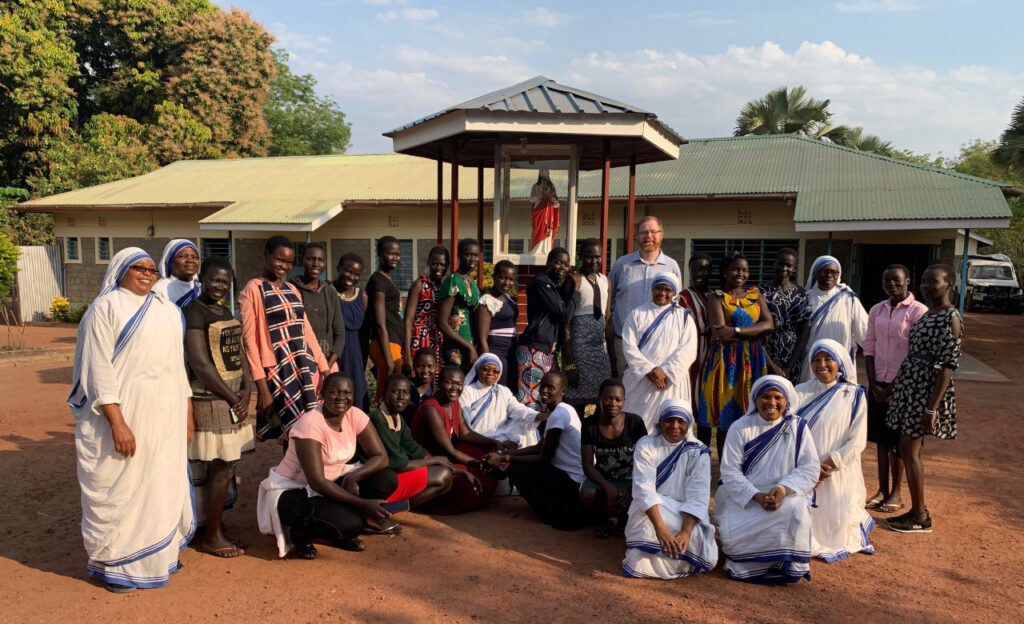
Missionaries of Charity Community
Neighbours are important. I think we’ve come to a deeper realisation of this over these last twelve months. If there is to be anything positive taken from 2020 it must surely be our shared reliance on one another. In addition to the heroic efforts of front-line workers, we have seen neighbours arrange shopping, collect prescriptions, and perhaps most importantly pick up the phone and call to make sure people are doing alright. Some might argue that we had lost this sense of community, but even if we did it’s back in a big way and not likely to be forgotten anytime soon.
Since I wrote last, we had our own Christmas in Loreto, which was both simple and wonderful. There were about thirty students and interns who had stayed with Sr. Orla and me for the holidays. On Christmas Eve we had a prayer service that began at sunset and ended with us singing Silent Night under a perfectly clear, stary sky. For Christmas Day itself Mass was celebrated in the school yard and some of the local villagers joined us in giving thanks for the birth of Our Lord.
This was followed by a special festive lunch of goat, chapatis, ingera, sukumawiki, and (for those of us Irish missionaries who might be feeling a little home sick) potatoes and tripe (an enthusiastic yes to the first and a hard no to the second!). Traditionally you eat the food using the flatbreads instead of cutlery. Sr. Orla managed without difficulty. I brought a fork. Eleven years in the Catholic Boy Scouts of Ireland taught me to be prepared!
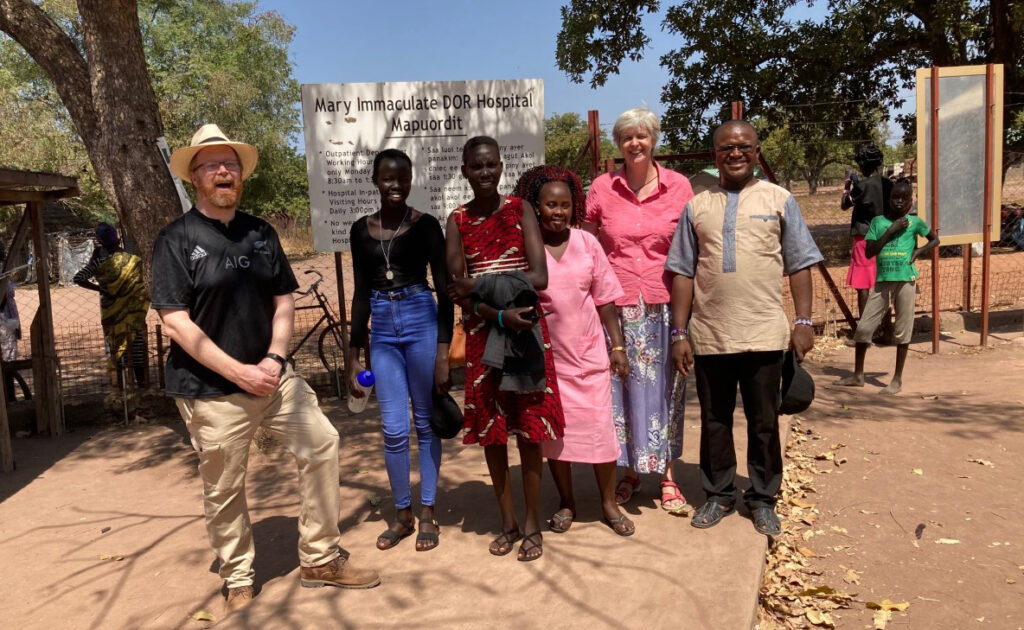
Mary Immaculate Hospital is run by the Comboni congregation and is one of the few health care facilities in the region with a surgical unit. This is led by Br. Rosario, who is also one of the hospital’s surgeons.
Christmas in South Sudan is all about visiting. People travel home to be with family and friends. They catch up with the local news, laugh over good times, shed a tear if there has been a tragedy, but above all they spend time together. The same is true for religious communities. Throughout the Diocese of Rumbek we have sisters, brothers, and priests from all over the world, working in a number of key ministries. There is little opportunity for down time, as the demands can seem unending. Visiting one another for a cup of tea, chatting over some lunch, or gathering for some prayer is truly priceless. Hospitality is both a special and necessary grace.
Our first port of call during Christmastime was to the Missionaries of Charity or Mother Theresa’s sisters to you and me. They work close to the Cathedral in a number of ministries for the poor, including a post-natal residential nutrition programme and an outreach project to a village of people with leprosy. The students came along as we celebrated an early morning Mass with them, followed by breakfast, which went down very well.
Our next stop during the holidays was Holy Cross Parish which is run by Spiritan Fathers, including Monaghan native Fr. John as the PP and Fr. Nolasco from Tanzania as the assistant pastor. They had just installed solar power in their church in time for the Christmas vigil. It is a real gift in a town without an operational power grid and where light at night-time is rare. In addition to their parish ministry, they are also in the process of building a primary school in the bush. St. Joseph’s should be ready for its first students later this year.
There is a firm belief that education is foundational in the development of South Sudan. While Loreto emphasises the importance of schooling for girls, our neighbours, Br. Eustace from Sri Lanka and Br. Joseph from South Sudan, are doing the same for the boys in the De La Salle Secondary School. What they are trying to achieve is more than just academic excellence. The schools promote a philosophy of education that is respectful of local culture, is rooted in Catholic values,and which forms the leaders of the future.
Our last visit was to the town of Mapourdit. Don’t bother trying to find it on Google maps. I’ve looked and it’s not there. The town itself was once a refugee camp but has now taken on a life of its own, in part because of the work of the Comboni Missionaries and our MSC sister congregation, the Daughters of Our Lady of the Sacred Heart. Br. Rosario, from Italy, is one of the two surgeons in Mary Immaculate Hospital.A brief tour of the facility showed us how they use the little they have to provide maternity care, malaria treatment, surgery for gunshot wounds, hepatitis vaccinations, HIV / AIDS programmes, and basically anything else you can imagine – 24 hours a day, 7 days a week. The Comboni hospital, the schools, and the parish are supported by Sr. Wendy, Sr. Rita and their lay associate Pauline, all from Australia, who have worked there for twenty years.
On leaving we found that we had an addition passenger. Fr. Placide, the PP who come from the Democratic Republic of Congo, surprised us with a goat to thank us for our visit. It was a long two and a half hours home over a bumpy road with a clearly irate and aggressively incontinent goat. In case you are wondering she is settling in fine in Loreto, but later this afternoon I have to clean out the back of the truck. A small price to pay to for seeing the remarkable difference religious are making here in South Sudan.
All in all, it was a very special Christmas indeed.
God bless,
Fr. Alan
HELP US TO TRANSFORM LIVES IN SOUTH SUDAN
Dec 22, 2020
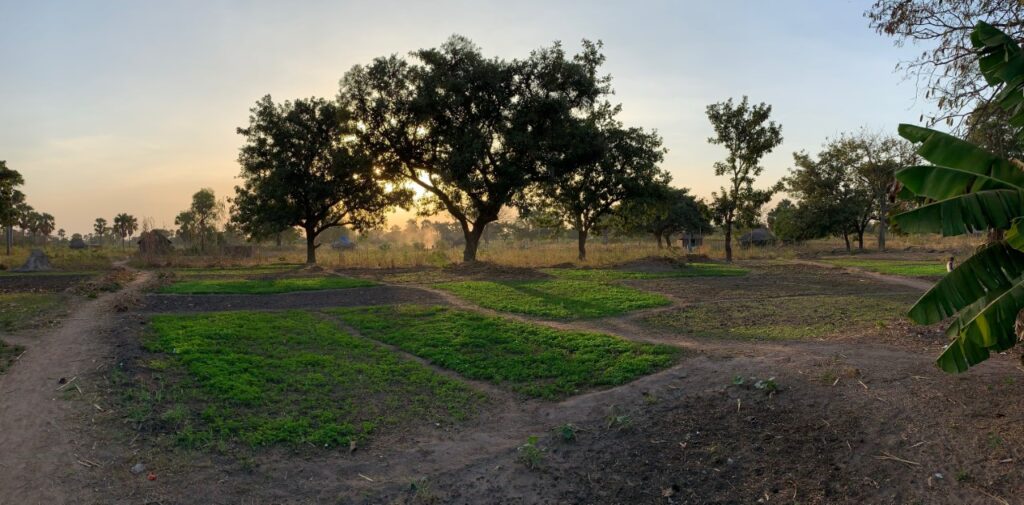
These are some of the kadua and sukumwiki that the local women grow to feed their families.
I don’t know how your morning is going, but I spent mine hunting down a jailbreaking duck. Born and raised in Cork City, I’m an absolute novice when it comes to anything to do with rearing animals or growing crops. I’m used to getting my eggs in cartons and my milk in convenient two litre plastic containers from Centra, so life here has presented some exciting new challenges. One thing is certain though, I’m not taking my food for granted any more.
Lorteo Rumbek does its best to make use of the land around the school to provide some of the food it needs for its students and staff. Each year for several months they grow groundnuts, a nutritious local staple. They also keep goats and pigs. In fact, just last week our community grew with the arrival of eight new piglets. And then there are the ducks, the newest members of my flock. Certainly not God’s smartest creation, but clever enough to give me a run for my money. After a quick Google search to confirm you can’t get rabies if they nip you (one was especially enthusiastic for his food two weeks ago), we’re getting on surprisingly well.
The food security that we take for granted at home, is wildly aspirational in South Sudan. Self-sufficiency and resilience are very much part of daily life. Localised fighting, an infrastructure severely damaged by flooding, and insufficient irrigation systems, mean many families live hand to mouth. Whatever meagre crops they grow must be watered long before dawn and late after sunset, to avoid the intense heat of the day. It involves long hours of backbreaking work, but the women who look after their small plots work miracles with the dry, sandy soil. In the villages around the school, Loreto has drilled several wells and set up hand pumps that provide much needed access to water. The people cultivate kadua and sukumawiki, both similar to cabbage, which they use to feed their families or, if they are fortunate enough to have a surplus, sell in the market.
Last night after Mass with the students, we were discussing the miracle of the Nativity and the simplicity of the stable for Jesus’ birth. For us, this experience of abject poverty shows usthe humility of God entering into our world in the form of a small, vulnerable child. However, it was explained to me that this is how children are born here in South Sudan all the time. Each home is made up of a number of tukuls or mud brick huts with grass roofs that house the families and any animals they have, sometimes sharing the same space for added security. This echo of the Nativity reminds me of how close Jesus was to those living at the very margins of society. There is no Christmas shopping here really and even if there was,there wouldn’t be the money to spend on such luxuries. Instead, the focus is on being together, to sharing the little they have, and being grateful for whatever blessings they have received.
While I’m intrigued by people living in such close proximity to their animals, I still haven’t entirely embraced the local way of life. My ducks and I need our own space. In the end it took the best part of twenty minutes for me to shepherd my errant duck back to his coop. It may have been my imagination, but I did get the sense that the rest of his flock welcomed him home with an awed sense of respect for his daring escapades. If I was being absolutely honest with myself, I think he probably deserved it.
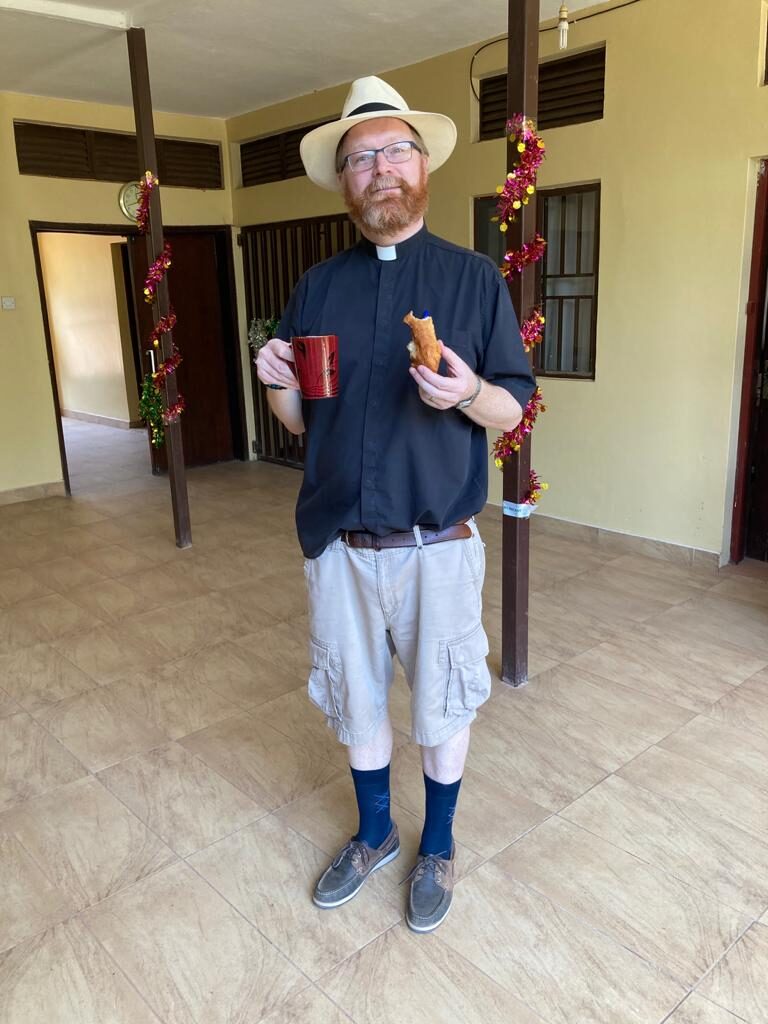
After the Sunday Masses, there’s always time to enjoy a coffee and a mandazi, a local South Sudanese cake.
We’re only three days away from Christmas, so from everyone here in Loreto Rumbek, we hope you have a joyful time as you celebrate the birth of our Saviour and a peaceful New Year.
God bless,
Fr. Alan
HELP US TO TRANSFORM LIVES IN SOUTH SUDAN
Dec 10, 2020
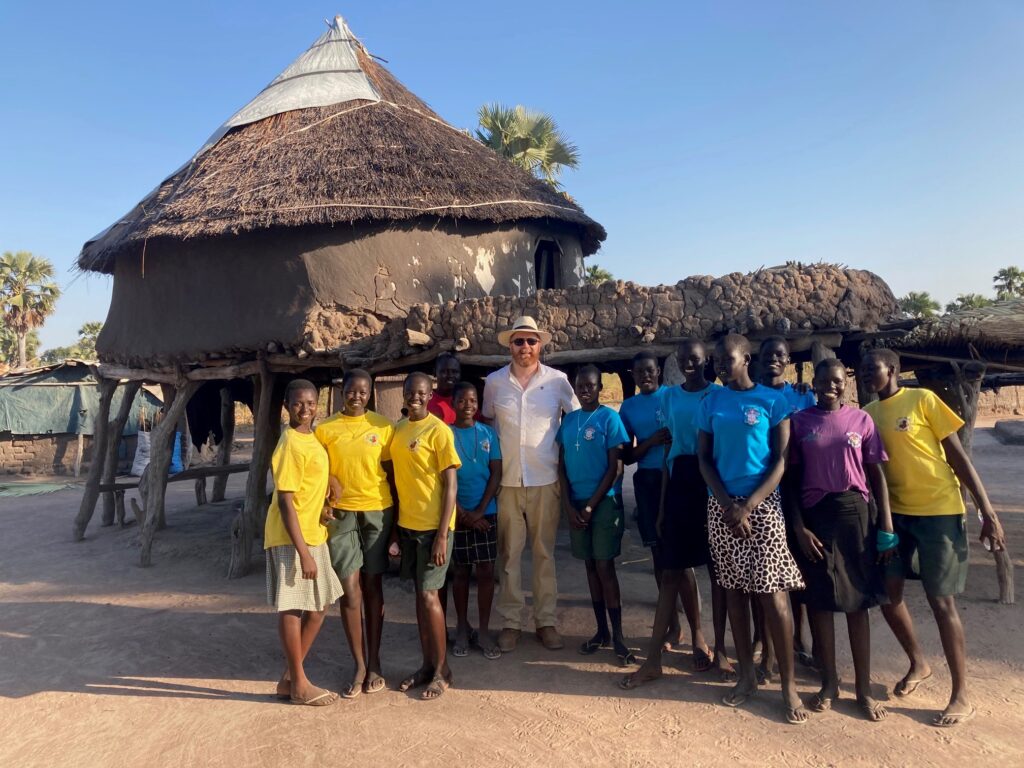
The mud hut behind us is a typical South Sudanese home in the countryside. Most of our students would come from places like these.
“It is coming up to a month since I first stepped off the plane at Rumbek Airport. Since my arrival, it has been a whirlwind of new experiences. The first thing you notice, in fact you can’t miss it, is the heat. I went from winter in Ireland to an average daily temperature of 37C and I was reliably informed that this was the coolest part of the year. I am fascinated that each morning there are people out and about with coats and a few wool hats. They in turn are mystified how I’m surviving sporting shorts and a t-shirt!
I am still settling into life at Loreto Rumbek and it has been a special privilege. It originally began as a school in 2008 under a tree in a scrub field five kilometres outside of the town, that was gifted to the sisters by a local chief. Its purpose was to educate young girls, a challenge in an environment where schooling was almost exclusively restricted to boys. South Sudan is still ranked as the world’s most difficult nation in the world for girls to receive an education, with only three out of a hundred having the opportunity to go to secondary school. Just over half of all girls are married before they are eighteen years old and almost one in five are married before they are fifteen.
When the Loreto Sisters began their work in Rumbek, they were told they were wasting their time. It was obvious to everyone that students wouldn’t come. They came. Then they were told the girls wouldn’t go on to secondary school. They persevered. Then they were told they wouldn’t graduate. Apparently, no one told the girls because they graduated anyway. To stand against the weight of cultural expectations requires a school that sees the very best in each student and a student with a courage of conviction that would be beyond most adults.
Over the last twelve years the project has grown from a few chairs under a tree and now includes a primary school with 1,200 children, a secondary with 300 girls, an agricultural project, and the newly opened primary health care clinic. It hasn’t always been plain sailing and 2020 has been especially difficult. The pandemic has caused widespread disruption around the world and South Sudan is no exception. However, Loreto has had their final classes of primary and secondary school back since autumn because they will still sit state exams in spring. We will need to keep them in our prayers.
Last Saturday we had a small, but significant celebration in the community. Five of the young women finished their two-year intern programme, where they had worked after their graduation in the school and the clinic as support staff. Now they were heading to university in Juba or Nairobi to continue their education, funded by Loreto. It is impossible to overestimate how extraordinary and important this is right now.
Over the years, graduates have gone on to study nursing, computing, teaching, business, logistics, and law. They are the pioneers who will blaze the trail for their younger sisters, making the impossible seem attainable. They are the firm rebuke to the people who say that it is a waste of time and money to educate girls at all. They are the entrepreneurs, the healers, the teachers, the leaders who will build a better South Sudan tomorrow, starting today.”
God bless or Bi Nhialic arrer kek yin as they say here.
Fr. Alan
HELP US TO TRANSFORM LIVES IN SOUTH SUDAN
Jan 22, 2020
Health and Education at Berea-Albion Football Club
Cougar Park in Pretoria, South Africa, is home to Berea-Albion Football Club and Academy, where disadvantaged youths are given hope and encouragement as they strive for a better future. The academy hosts up to 60 students at a time, with 50% coming from non-privileged backgrounds and 50% coming from more fortunate circumstances.
“The majority of disadvantaged youths in our development programmes are orphans, or they come from single parent families,” says co-founder Neil Bosman. “They have struggled with poverty, HIV/AIDS, abuse, alcoholism, and poor educational backgrounds.”
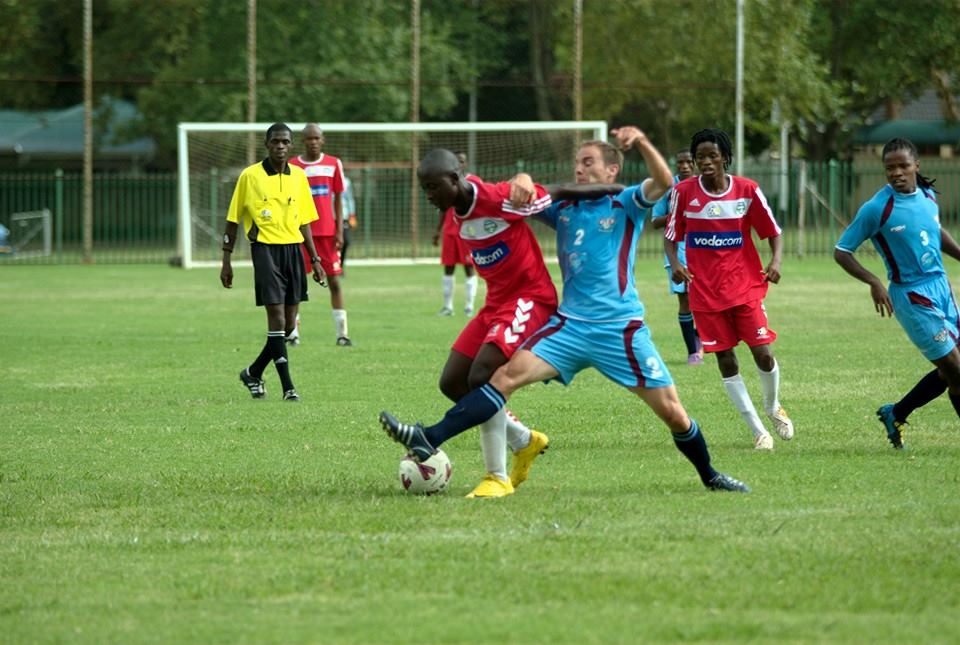
There are currently 21 former Berea-Albion students playing top-level football around the world. However, there is also an awareness that not all students will reach professional level, and every player is prepared for a successful future with the combination of educational, social, and health structures taught at the academy. Students attend Bosman College, where the focus is on providing “a sound education base” as well as full professional training in football.
The academy’s motto is “Passio Pro Perfecto” (a passion for perfection), and the Missionaries of the Sacred Heart have been glad to be able to support them in their great work in the past.
“We sincerely thank you for any support you can provide,” says Neil Bosman. “All donations are being put to very good use as we make sure that our young footballers are housed, clothed, educated, trained, and nutritiously fed at Cougar Park.”
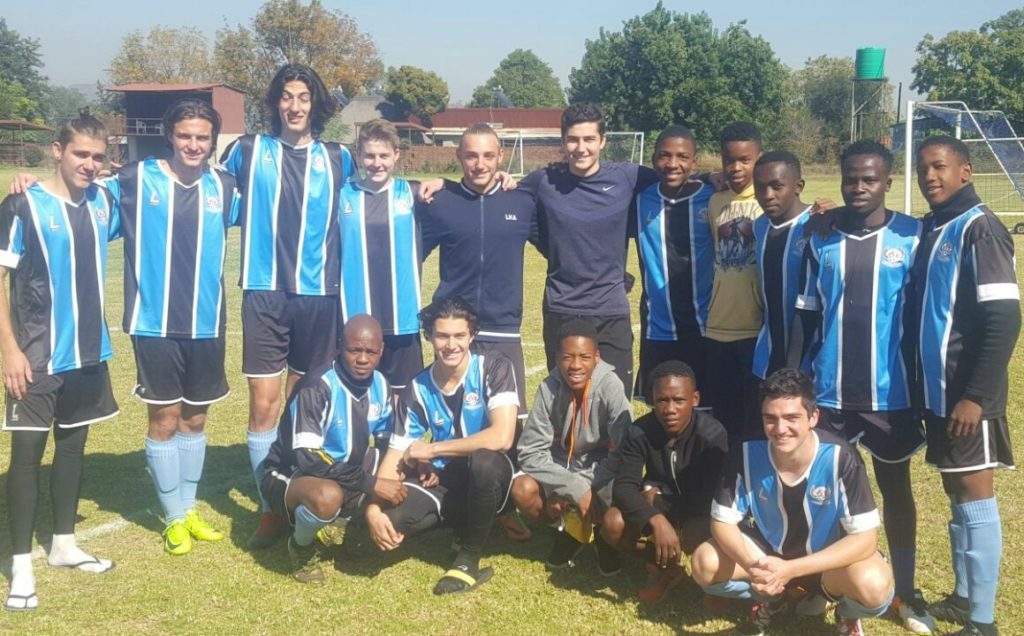
A donation of just €50 will provide a pair of football boots and a ball for a student,
providing essential tools in these invaluable youth development programmes.
CAN YOU HELP OUR MSC MISSIONS IN SOUTH AFRICA?
MSCs working with the Sisters of St Therese
A group of Sisters of St Therese from the Democratic Republic of the Congo are working with the MSC community in South Africa to minister to local communities in need of pastoral aid. Together, the Sisters and MSCs do great work in the area of Rabie Ridge, a very poor township in Ivory Park parish, located outside Johannesburg.
Many of the Sisters are qualified teachers, but they live on very little. They have no means of travel apart from public transport, making extended ministry more difficult, and they live on minimal food and provisions themselves.
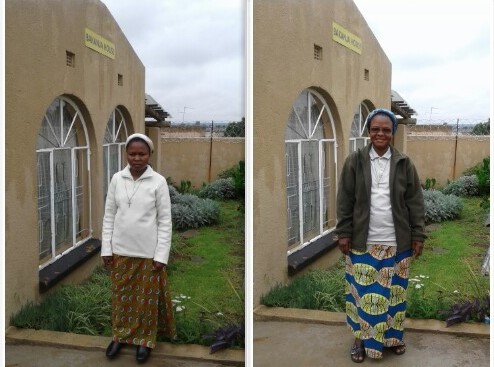
The house in which the Sisters live has recently undergone some repairs, as it was in a terrible state – particularly the roof, which regularly let rain in. The house is now in better repair, but the Sisters are still in need of a comfortable space in which they can pray. The extension of their chapel space is estimated at a cost of just over €1,500, and this will provide the Sisters with an essential place of prayer.
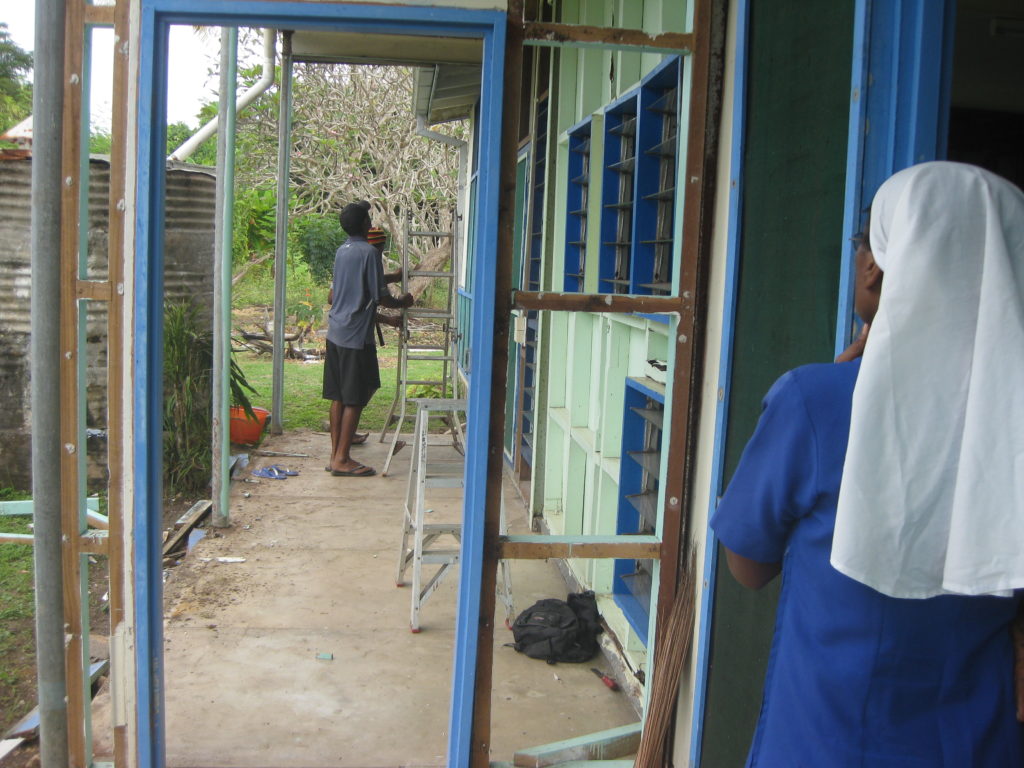
The Sisters also run a feeding scheme for children in local primary school St Gemma’s, with 25 children who have been orphaned or who come from vulnerable backgrounds taking part in the programme. From Monday to Friday, the children have a nutritious lunch at 11.00am; however, the Sisters are under real pressure to maintain this due to a severe lack of funding.
It costs less than €2 per day to feed one primary school child
– a total of just over €230 for a week’s food for 25 children.
A small donation can make a great difference.
PLEASE SUPPORT OUR MSC MISSIONS IN SOUTH AFRICA