Feb 24, 2022
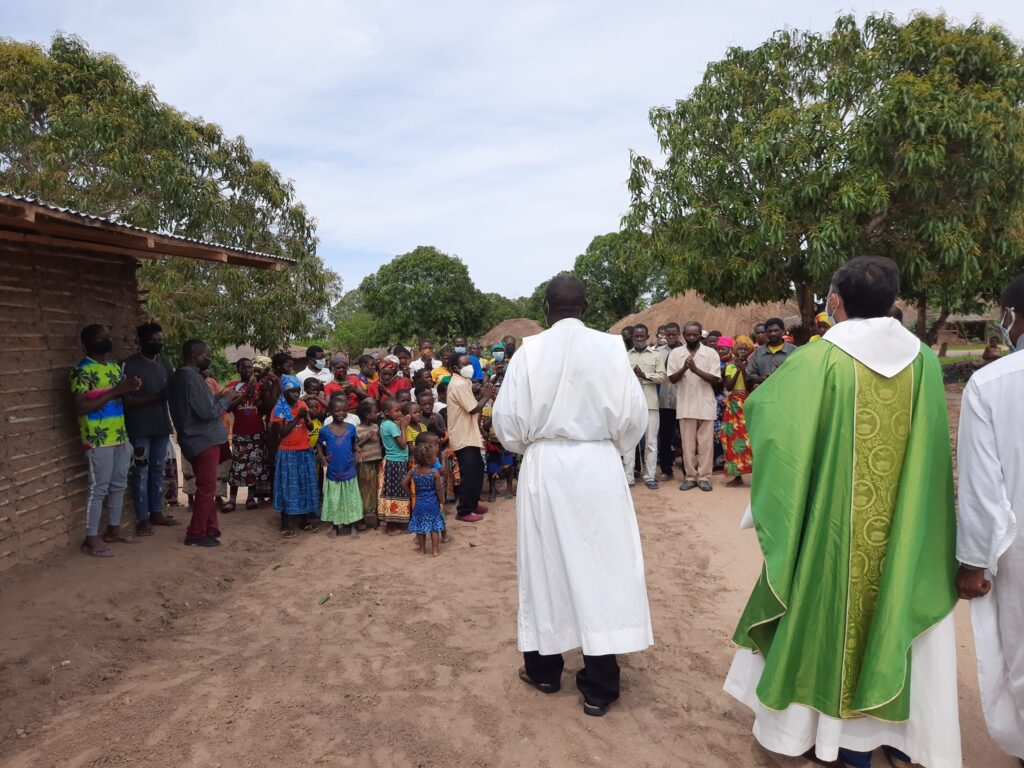
In early February, MSCs on our Mozambique mission celebrated Mass with the community of St Augustine, in the parish of Saint Anthony in Metuge.
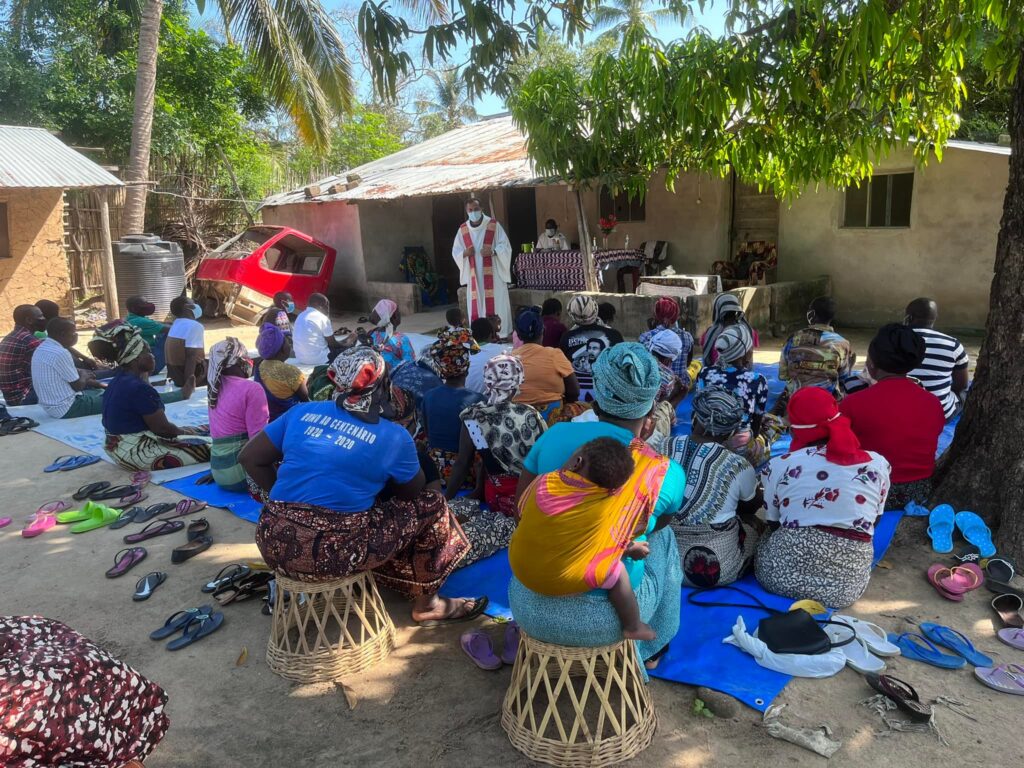
As there is no church in the area, Masses and prayers were celebrated by our MSCs in families’ homes, with a great spirit of unity and togetherness. God’s love is a hugely compelling factor for these families and communities, and they celebrate their faith in any and every way possible, given the lack of facilities in the region.
Just a few weeks earlier, the community in Metuge had a wonderful day in the celebration of several sacraments, including confessions, baptisms, First Holy Communions, and marriages. Once again, all of these events took place outdoors in the shade of the trees, with an enormous sense of unity and community.
Now in its fourth year, the MSC Mozambique mission has celebrated with local communities in times of joy, and has walked with them and helped them rebuild in the wake of natural disasters. Our MSC missionaries continue to make the love of the Sacred Heart known in this area of real need; please keep our MSC missionaries and people they serve in your prayers.
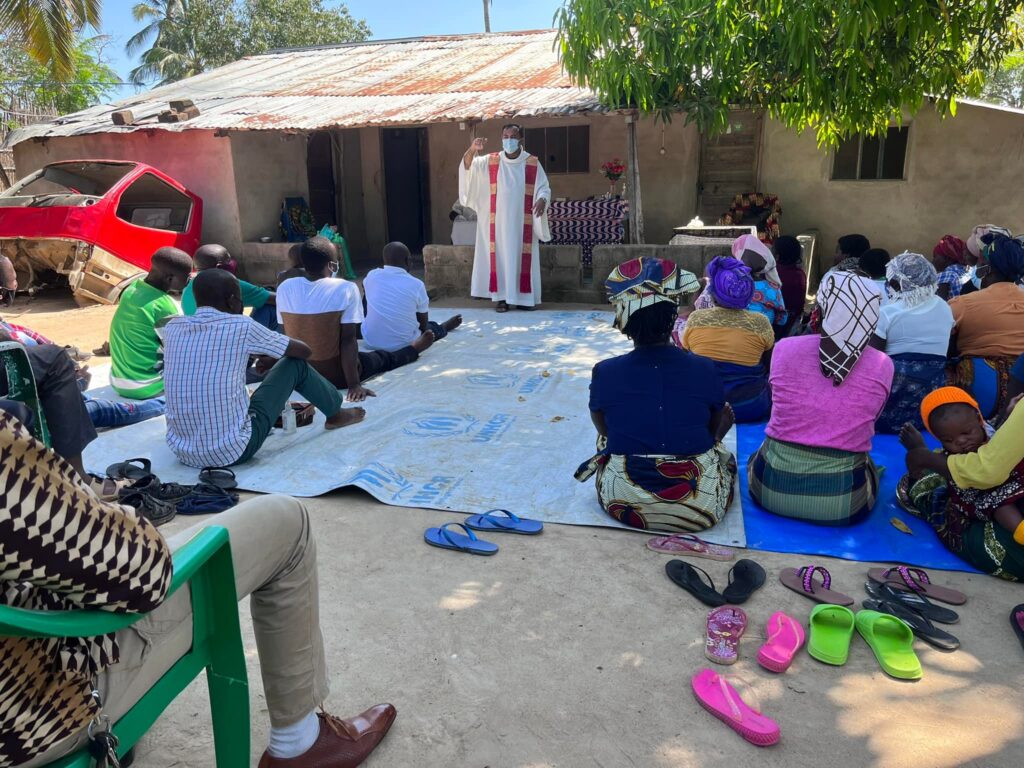
Images via the MSC Mozambique Facebook page.
*
Feb 17, 2022
The end of January marked a day of momentous celebration in Metuge, in Cabo Delgado, Mozambique.
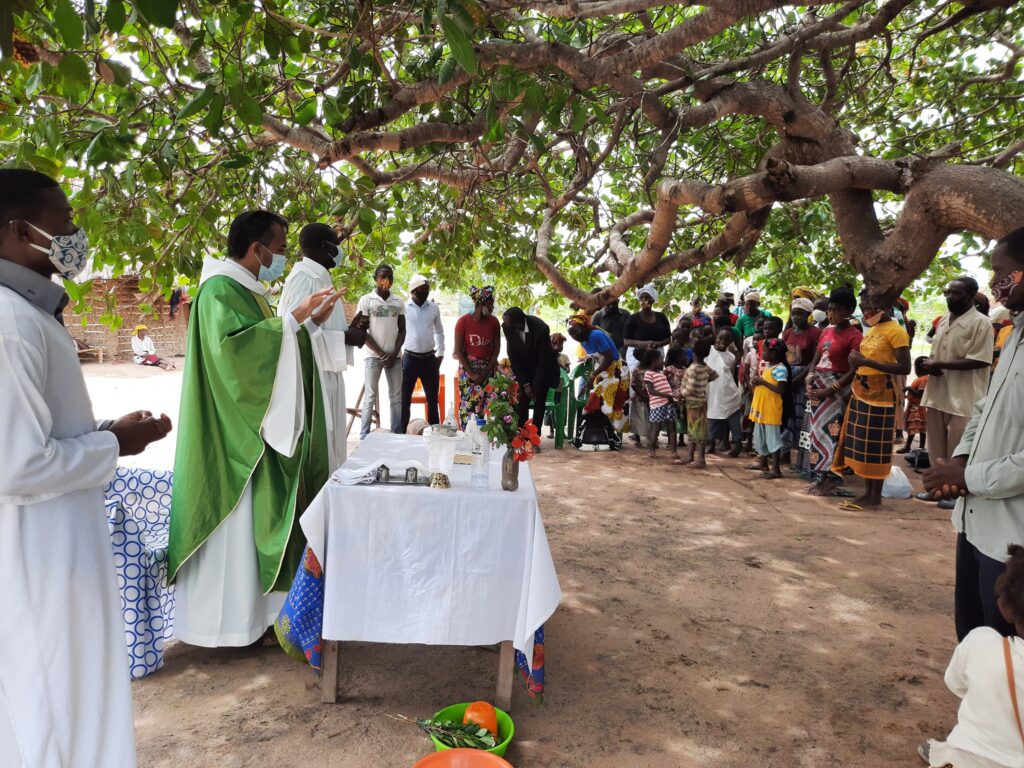
On Sunday, January 23rd, MSCs in Metuge presided over a host of celebrations in the community of São Mateus of the Parish of Santo Antônio de Metuge, including confessions, baptisms, First Holy Communions, and the marriages of two couples.
A day of true unity and community, the spirit of celebration was a joy to behold for all involved.
The Mozambique mission began in March 2018, with MSCs from Brazil ministering in the Pemba diocese – an area of extreme poverty and hardship, where up until that point, local families had no access to church infrastructure or pastoral ministry.
Our MSCs have been tireless in their work to bring about positive changes for local communities, in spite of a number of serious challenges, including the impact of two devastating cyclones which took place just six weeks apart, a year and a half after the mission began.
MSC missionaries had already been working to rebuild struggling communities in the area before the cyclones hit, and in the wake of these disasters, they continued to help those who had lost friends and family members in the disasters, as well as over 21,000 people who had been left homeless.
Our MSC missionaries have been helping local families to rebuild their lives and livelihoods over the past four years, continuing in their mission to share the message of God’s love in this area of real need. The strength, resilience, and spirit demonstrated by local communities is an inspiration to behold, and days such as these provide much-needed encouragement and motivation to all involved in the mission. This wonderful day of celebration in Metuge has been a great success for the local community; with blessings and good wishes to our MSC brothers and all who took part!
Images via the MSC Mozambique Facebook page.
*
Feb 11, 2022
It is an Irish truism that if you dig a good ditch, you don’t get time off, you get a bigger shovel. Apparently this is not just Irish wisdom, but South Sudanese as well. In addition to the work in Loreto College, I have been drafted by the Diocese of Rumbek to help run the local Catholic University. At this point of life you’d imagine I’d have learned to keep my head down.
It may sound a grand affair, but it is certainly a lot more simple than you’d imagine. We have a roof, but no ceiling; windows, but no glass; and floor with no tiles. The less said about the two pit toilets that serve the campus the better. Just today we had the cleaner in to take care of the bat infestation in the library, that also serves as the office. Having droppings continually fall on the desk during an academic meeting is distracting to say the least.
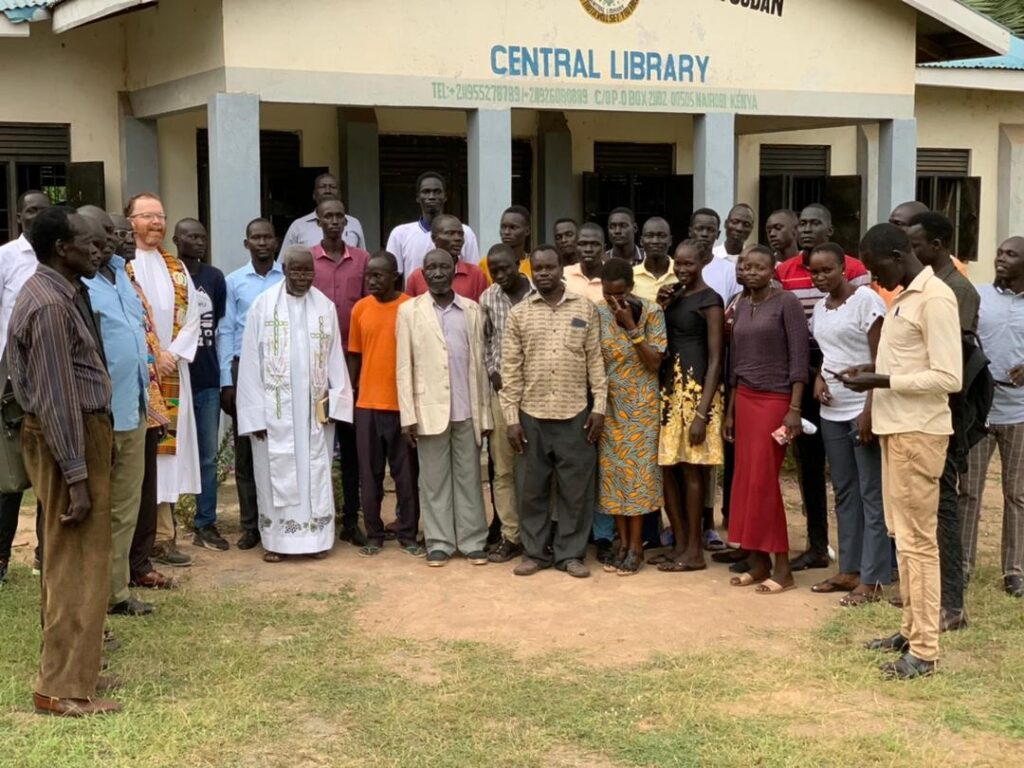
“Group photo from the My First Mass at the University showing the library with all the bats right behind!”
Initially I took on the role with the expectation that it would be a short term appointment. In fact, early on there was even a discussion around closing the University altogether. Still, it is one thing to consider in a meeting room, surrounded by pages of accounts, and entirely another to act out once you have met our students.
At the moment we have a sum total of 59 women and men studying either business administration or teaching with a focus on English literature.They are almost all from Rumbek, with only a couple from further afield. Some have come straight from school, while others are looking for new opportunities later in life. All are committed and enthusiastic about their third level studies. It is something to see really.
It takes a lot of energy to get worked up about a computer class, without computers, but with a drawing of a Windows home page on a blackboard.
This was one of the first classes I visited when I began. Since that experience of ‘theoretical computing’ we have been able to set up a relationship with a Jesuit community not so far away that runs a computer course – with actual computers!
We are also seeing an exciting new development. In traditional culture here, once a woman has her first baby she leaves formal education to focus full time on child rearing and subsistence farming. However, so far I have met a number of young mothers who are coming back to study, with their new born under their arm. It is unprecedented and we are looking at ways of supporting them and their young families. I mentioned the idea of a creche, but so far I’ve been met with looks of incomprehension. Honestly, if it wasn’t for the initiative of a particularly creative Donegal MSC setting up a parent and toddler group in one of my old parishes I wouldn’t have a clue either. We’re working on it. Watch this space.
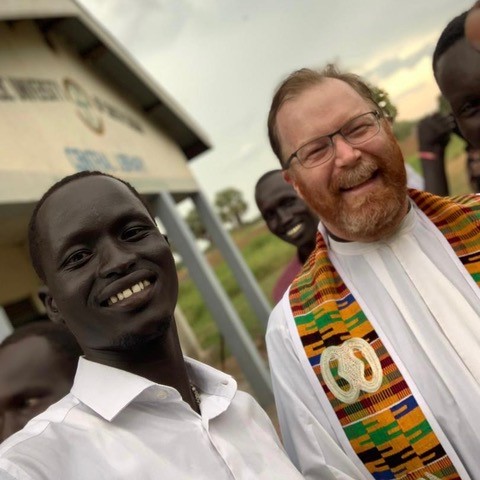
“My first Mass at the University.”
For me the main reason the University is so important is that we are the newest country in the world and we really need to develop the local economy. It has to be stimulated by well trained, committed teachers and hardworking, innovative business people. Charity is excellent for crisis situations. It’s an act of solidarity and compassion for someone you will never meet, but who you are ready to call brother or sister. However, charity is not a long term strategy and instead we need to increasingly invest in people on the ground to effect their own change, not just raising up themselves and their families, but entire communities as well.
The motto our small University is, The Truth Shall Set You Free. Our faith underlies everything we do here. Religious sisters, brothers, and priests are among the best educated in the area and they are working as lecturers in ethics, management, business, and education. We have great local educationalists who are taking the lead too. I spoke with one them today, as we were cleaning up the last of the bat droppings from the top of my desk, that in five years we’ll look back and have a good laugh at everything we went through to become a real third level college. In the meantime there is a lot of work to do. I’d better get my shovel.
Bi Nhialic arrer kek yin,
Fr Alan
Read more from Fr Alan’s missionary journey in South Sudan:
PLEASE HELP US TO TRANSFORM LIVES IN SOUTH SUDAN
Feb 10, 2022
Established in 2018, the MSC Centre for the Poor is located in the city of Butuan in the Philippines, and focuses on harnessing the gifts of the natural world to combat poverty, unemployment, and the exploitation of the ecosystem – work in which “everyone is called to be a partner in the contribution of healing our land”.
The Irish Province of the Missionaries of the Sacred Heart have a long-standing friendship with the community at the MSC Centre for the Poor, and community leader there, Fr Richie Gomez MSC, has recently been in touch with an update on the work going on in the centre, following their most recent “Be a Food Security Frontliner” campaign.
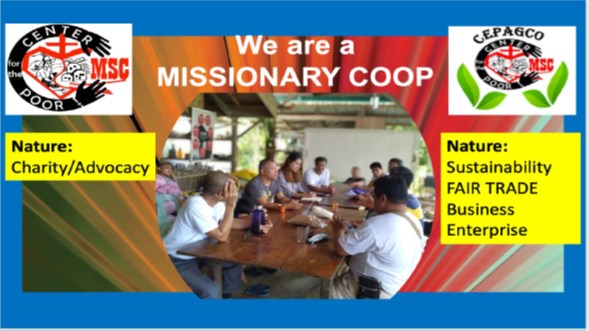
“An alternative lifestyle that is good for the well-being of all”
The goal of the community at the Centre is “to promote an alternative lifestyle that is good for the well-being of all”, with a co-operative running across the two MSC Centre for the Poor locations, one in Butuan City and one in Del Monte Agusan del Sur. Focusing on the development of a self-sufficient community, where those involved nurture the earth and reap the benefits in return, the current programme incorporates the following goals:
- The development of healthy soil and fresh organic produce, to contribute to a plentiful and nutritious diet for members of the co-operative.
- The development and use of safe, ecologically balanced technology to tie in with the concept of organic sustainable farming employed by the MSC Centre for the Poor.
- The development of a deeper consciousness of managing waste with the aim of a zero-water lifestyle in all kitchens across the co-operative.
- The development of income-generating projects and additional efforts to raise the quality of life of the rural poor.
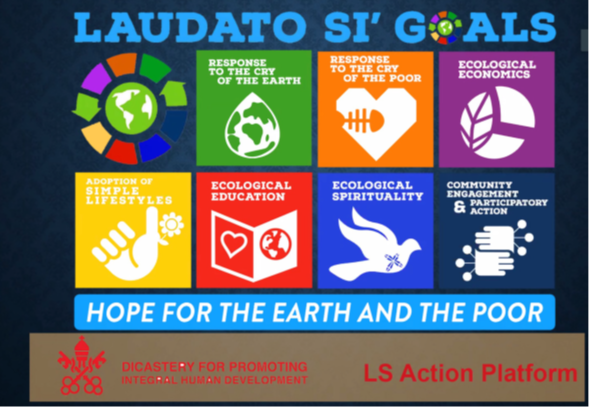
- The continued raising of awareness of the necessity of caring for the environment in response to the ongoing climate emergency.
“From the tiniest seeds to a grown tree, from the fertilization of eggs to completely matured animals, from planting to nurturing, growing, and harvesting, all of these processes are realized because of tender love and care, whether by nature or by a responsible steward,” writes Fr Richie. “We have to stop abusing and poisoning the soil, water, air and our bodies, for us to allow the natural regeneration process of our environment.”
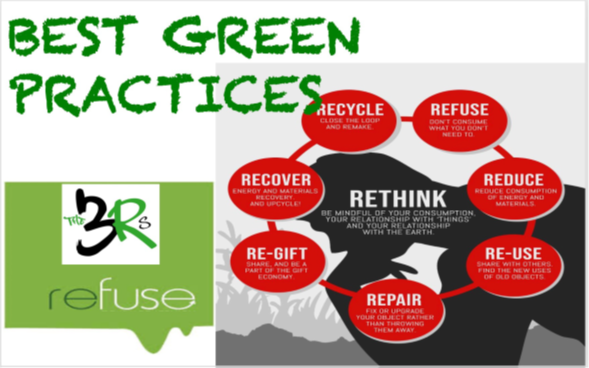
“Farm-to-table connections”
The MSC Centre for the Poor community are continuing work on the establishment of a fair-trade system based on an inclusive economy, whereby nobody will be left out through “farm to table connections” that bypass large commercial traders. Consumers are educated about the lives and work of the farmers that grow the produce they buy, and all of this produce is grown organically, without chemical interference.
“We have a sincere desire for change – not to make false promises but to be true to our conviction for total transformation from ‘ego-system’ to ‘eco-system’,” explains Fr Richie. “We value the collective efforts of our co-op members through the establishment of their own farms, and we bring them together at the Centre’s Trading Post Harvest Facility. Then, we become the green producers and bring our products to the green consumers.”
The MSC Centre for the Poor is conscious of upholding their responsibility to the consumer, noting that each member of the co-operative must “fulfil its obligation to produce and supply with the corresponding demands. Each member of the co-op is tasked to be part of the responsibility and must be prepared for the assigned crops or livestock productions.”
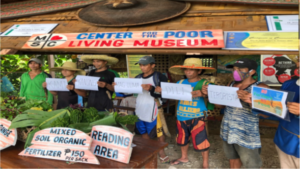
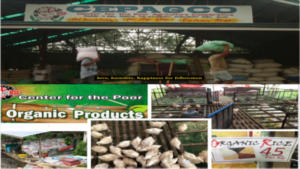
“As long as there are people who believe and trust in us and in regaining one’s relationship with the environment, this work will sustain.”
The community at the Centre for the Poor benefit greatly from a wonderful team of volunteers. “Volunteerism is one of our core values to meet our goals, as we believe that by helping others, we help ourselves.”
“As long as there are people who believe and trust in us and in regaining one’s relationship with the environment, this work will sustain,” continues Fr Richie. “We are an emerging social enterprise that allows individuals to create regenerative livelihoods that nourish the soul and take care of the planet.”
“The honing of the land to its full potential will create multiple revenue streams, while we will implement a model of an assets-based community. This is a closed-loop system that generates and replenishes the earth’s resources without creating waste and ecological harm.”
The MSC Centre for the Poor also operates a “Living Museum” of farmland in Del Monte Agusan del Sur. “Our farmland will be stewarded by the members of the co-op who are ready and willing to embark on a pathway of alternate living,” says Fr Richie. “The goal is to allow for choice around intentional community and to create the opportunity for lifelong learning for everyone.”
“Our priority is to meet the needs of each member and the land. We will create a full-featured settlement that allows all of the functions of everyday life. The community will provide a place to live, make things, enjoy leisure, and honour social connections. We will encourage individuals to find their own niche for self-expression, livelihood, and growth. Everyone will have the opportunity to co-create the change they seek.”
“A fertile community allows for the emergence of a new culture rooted in a deep connection to nature and the self, collective consciousness of ecology, and mutual respect between all living beings.”
Feb 3, 2022
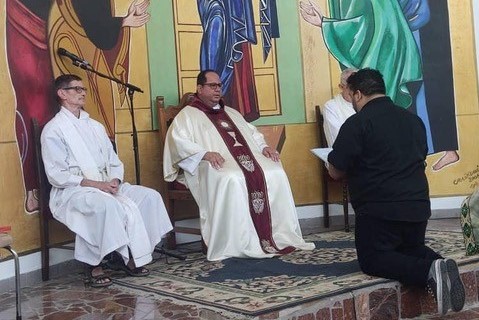
The beginning of 2022 has brought great joy for the MSC community in the Venezuelan Region, with Miguel Ibarra MSC renewing his vows on Saturday, January 29th, and Yordy Blanco MSC making his First Profession on Wednesday, February 2nd.
Vow renewal of Miguel Ibarra MSC
Miguel Ibarra MSC, a member of the Irish Province of the Missionaries of the Sacred Heart in the Missionary Community of Venezuela, made his First Profession in February 2021 and renewed his temporary vows in Caracas on January 29th, 2022. Due to ongoing COVID-19 restrictions, the celebration was a small, private one, attended by some family members, but nonetheless special for it. A beautiful Mass was celebrated by Fr Tom O’Brien MSC and Fr John Jennings MSC, while Miguel’s vows were received by Fr Yonys Mendoza MSC.
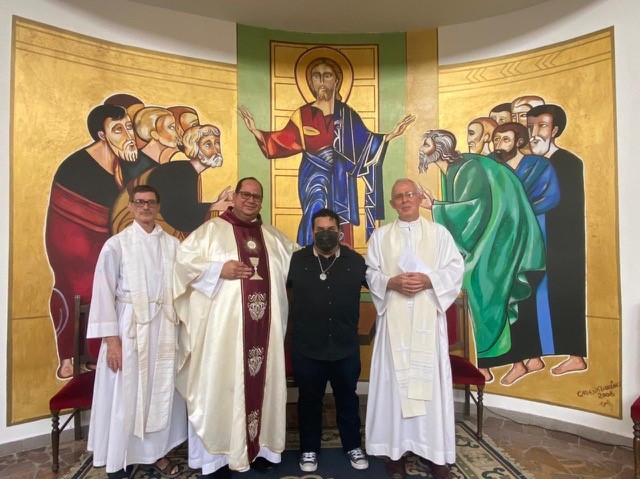
After spending some time at home with his family, Miguel is due to return shortly to São Paulo, Brazil, to continue his theology studies in the MSC Scholasticate.
First Profession of Yordy Blanco MSC
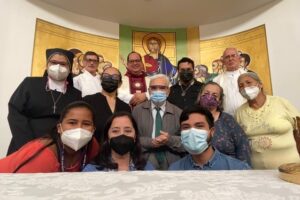
Miguel will soon be joined at the MSC Scholasticate in São Paulo by Yordy Blanco, a fellow member of the Irish Province of the Missionaries of the Sacred Heart in the Missionary Community of Venezuela, who took his First Profession vows in Brazil on Wednesday, February 2nd (the Feast of the Presentation and the 2022 World Day of Consecrated Life). Yordy completed his noviciate year in Itajubá in Brazil, and made his First Profession alongside his fellow novices, Diego Zambrano, Guicherme Bernal, Mateus Borodiak, Pedro Henrique, and Valmir Silva. These six young men are members of the Provinces of Rio de Janeiro, Curitiba and Sao Paulo, the Section of Ecuador, and the Missionary Community of Venezuela. The Mass was presided by Fr Humberto Henriques MSC, Assistant General, and the vows were received by the Provincials of the three Brazilian Provinces. (If you would like to watch the full First Profession ceremony, please click here.)
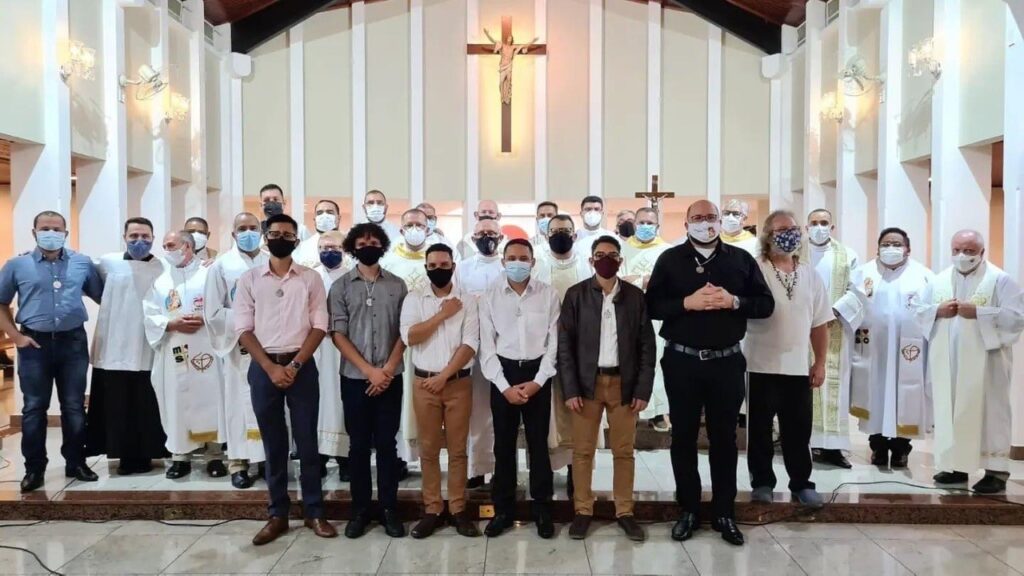
“We extend our heartfelt congratulations to Yordy and wish him and all his fellow novices a beautiful celebration,” wrote Irish Provincial Leader Fr Carl Tranter MSC, ahead of the profession ceremony. “May their lives as MSCs be filled with joy and fulfilment. Congratulations also to the MSC community in Venezuela as they welcome Yordy to their small but powerful group of missionaries.”
“I extend our special thanks to the São Paulo Province for welcoming Yordy into their common Brazilian Noviciate,” continued Fr Carl, “and especially to Fr Getulio Saggin MSC, Novice Master, for his kind, gentle and close accompaniment of the novices throughout the year.”
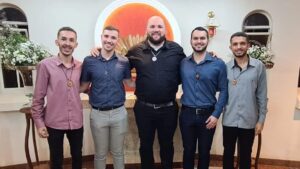
We add our prayers to Fr Carl’s as we wish both Yordy and Miguel every blessing for the next step of their missionary journeys ahead.
*
Jan 27, 2022
The Daughters of Our Lady of the Sacred Heart in Itajubá, located in the state of Minas Gerais, Brazil, are raising funds to launch a new project titled “Bakery Bread at the Table”. The funds raised will purchase the machinery to equip a bakery, which will primarily feed 200 children, with the additional aim of providing training workshops for adolescents who are in a situation of social and financial vulnerability, allowing them to gain valuable skills and qualifications which will help them in seeking employment.
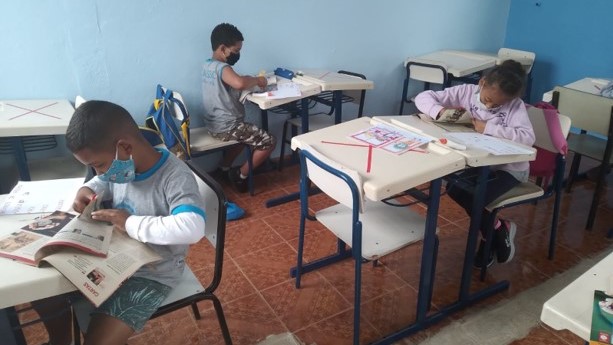
Some of the issues encountered by young people in the region include drug trafficking, prostitution, violence, and criminal activity. This project, with its introduction to both practical skills and a creative element, is a wonderful vehicle to promote healthy development in local youths, offering them an opportunity for alternative ways of living outside of their harsh reality.
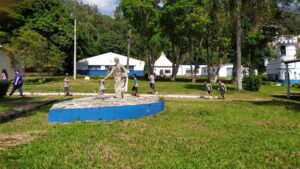
This project will serve approximately 200 children and teenagers from needy and low-income families, aged between 5 and 13 years. The youths involved will learn to cook and bake a variety of foods, including bread, pies, pizzas, and cakes. Students will be engaged throughout the entire process, from gathering and mixing the ingredients to cleaning the machines and equipment in the aftermath of a cookery session.
It will cost €8,300 to get the bakery up and running,
providing invaluable opportunities for local youths and their families.
Can you help?
PLEASE SUPPORT OUR OLSH BAKERY IN BRAZIL