May 18, 2019
Gospel Reflection
In his departure discourse from this world, Jesus gives a new commandment –
a commandment for the new age to come with his resurrection and in eternal life.
It is in keeping with the vision of the New Jerusalem of today’s second reading, something worth reflecting on.
The Gospel (John 13:31-35):
I give you a new commandment: love one another.

1. New Heaven and New Earth.
One of the articles of the Creed is that we believe in life everlasting, where the just enjoy the presence of God in the Beatific Vision, the trials, persecutions, and worries of this present life behind them. It is obvious to believers, and has been down the centuries, that this world cannot be as God would have it. Paul has said as much to the Romans (Romans 8:20-23): “For the creation was subjected to futility, not of its own will but by the will of the one who subjected it, in hope that the creation itself will be set free from its bondage to decay and will obtain the freedom of the glory of the children of God. We know that the whole creation has been groaning in labour pains until now; and not only the creation, but we ourselves, who have the first fruits of the Spirit, groan inwardly while we wait for adoption, the redemption of our bodies”. There arose the belief that after history had run its course, there would be a new creation, as expressed in the Second Letter of Peter (2 Peter 3:13): “But, in accordance with his promise, we wait for new heavens and a new earth, where righteousness is at home”. This belief is also clearly expressed in today’s second reading (from John’s Apocalypse). The Church takes note of this expectation, both in the Pastoral Constitution on the Church in the Modern World (Gaudium et Spes, “Joy and Hope”), paragraph 39,2, with the reminder that rather than take from, it should add to, our concern for the world in which we live: “Therefore, while we are warned that it profits a person nothing if he gain the whole world and lose himself, the expectation of a new earth must not weaken but rather stimulate our concern for cultivating this one”.
2. The kingdom of God is among us.
His kingdom would mean care for one another after his example and his command. He made this clear by washing the feet of his disciples and his explanation of the meaning of this: “I have given you an example”. He came to bring life in its fullness, life here and life hereafter. This life was about one’s soul, one’s true inner self, with a knowledge of the meaning of life and the handling of trials. The same message is still proclaimed in the Easter liturgy, as in the following text from one of the prefaces for the Easter Mass; when Christ our Passover has been sacrificed: “For with he old order destroyed, a universe cast down is renewed, and integrity of life is restored to us in Christ. Therefore, overcome with paschal joy, every land, every people exults in your praise and even the heavenly Powers, with the angelic hosts, sing together the unending hymn of your glory, as they acclaim: Holy, Holy, Holy”.
Fr Martin McNamara MSC
May 17, 2019
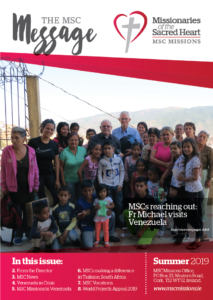
Welcome to the Summer 2019 edition of the MSC Message!
• Read a special summer greeting from Fr Michael O’Connell MSC, Director of the MSC Missions Office.
• Catch up with the latest news from the mission fields, with updates from our ongoing projects in South Africa and India.
• Find out about this year’s MSC pilgrimage to Lourdes.
• Read all about Fr Michael O’Connell’s visit to our MSC parishes in Venezuela.
• Enjoy updates from World Youth Day 2019 in Panama, where Fr Alan Neville MSC and the MSC Vocations Team celebrated earlier this year.
Read the MSC Message Summer 2019
May 16, 2019
Sincere congratulations to the Rev Fr Toussaint Iluku Bolumbu MSC, who has been appointed by Pope Francis as bishop of the diocese of Bokungu-Ikela, Democratic Republic of the Congo.
Currently acting as superior of the Missionaries of the Sacred Heart for the French-speaking African region, Bishop-Elect Toussaint is the first MSC African bishop.
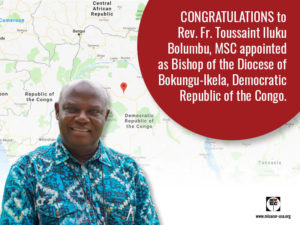
The bishop-elect was born in Monieka, Zaire (now the Democratic Republic of Congo), in November 1964, the seventh in a family of eleven children. He entered the novitiate of the Missionaries of the Sacred Heart, and was ordained a priest in 1995, having professed his religious vows the previous year. He holds bachelor’s degrees in both philosophy and theology, and has served in a wide range of pastoral roles including parish priest, vice rector, bursar, and later superior and director of formation of the MSC School in Yaoundé, teacher of philosophy and theology, vice president of the Association of Major Superiors of the ecclesiastical province of Mbandaka-Bikoro, assistant to the secretariat general of the General Chapter of the Missionaries of the Sacred Heart in Rome, and moderator of the General Conference of Missionaries of the Sacred Heart in Yaoundé.
In April, Rev Fr Toussaint was appointed fourth bishop of the diocese of Bokungu-Ikela. His ordination will take place on July 21st in Bokungo, by Bishop Fridolin Ambongo Besungo, Archbishop of Kinshasa and Apostolic Administrator of Mbandaka Bikoro.
We send our very best wishes to Bishop-Elect Toussaint
from the Irish Province of the Missionaries of the Sacred Heart!
May 9, 2019
We are delighted to have received a letter from Br Jean Manga MSC with an update from our MSC community in Righini, Congo.
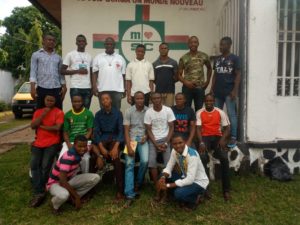
Earlier this year, we reached out to our mission friends to help the MSC community in Righini as part of our 2019 World Projects Appeal. 15 MSC pre-novitiate students live in the Formation House in Righini, along with their two formators. Here, they work, study, and pray together as they contemplate the missionary journey. The residents of the formation house live primarily on a grant provided by the MSC French African Union – a grant which allows each person a sum equivalent to €11 per day.
As part of their daily routine, the pre-novitiate students travel to the local university to attend classes. They also travel around the surrounding areas, visiting parishioners and undertaking parish ministry. An old minibus served as their only mode of transport, until it broke down beyond repair in April 2018.
For the past year, our MSC students and their formators have had no choice but to travel on public transport, which is unpredictable, undependable, and time-consuming. The community has been unable to travel together, and the lack of transport has made it very difficult for duties around the parish to be undertaken efficiently and effectively. It has also incurred great costs, with $10 per day spent on public transport as opposed to the cost of fuel for the minibus at $30 per week.
The support and generosity of our mission friends here in the Irish Province meant that we have been able to contribute to the cost of a new minibus, and Br Jean has sent a message of thanks from Righini.
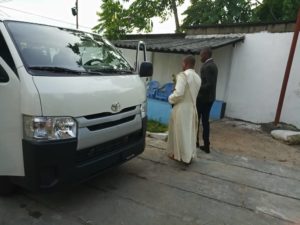
“We thank the Lord for you and your great generosity,” he writes. “You have made it possible for our pre-novitiate students to have a brand new school bus. After many months of hope, the bus is now with us.”
“You have our sincere gratitude,” he continues. “God bless you fully!”
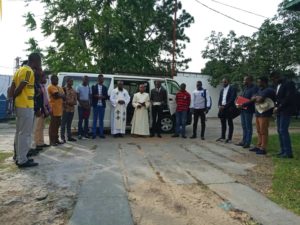
We would like to join with Br Jean in extending our heartfelt thanks to all who have contributed to our ongoing 2019 World Projects Appeal. Every contribution, no matter how small, helps us to change lives for the better across the world.
PLEASE SUPPORT OUR MSC MISSIONS
May 2, 2019
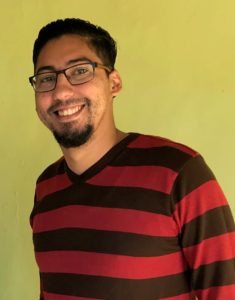 We have great joy in announcing that on Saturday, May 4th, Luis Gonzalez MSC will be ordained a Deacon in Caracas, Venezuela.
At a time when the country is going through such a difficult period politically, socially, and economically, it is a sign of great hope that a young man such as Luis commits himself to the service of the people of Venezuela with the deep desire to be for all a living, tangible presence of God’s heart for his people. We pray for Luis on this significant step in his vocational journey, that he may serve the Lord, the Church, and all of society with love and generosity. Congratulations to Luis, his brother MSCs in Venezuela, and his family.
As we keep Luis especially in our prayers these days, we also continue to pray for the whole country of Venezuela.
– Fr Carl Tranter MSC
Irish Provincial Leader
Find out more about our missionary outreach in Venezuela