Jan 27, 2022
EDUCATION AT THE CHEVALIER TRAINING CENTRE
Established by MSCs in 1992, the Chevalier Training Centre is located in Wainadoi, in Namosi, Fiji, and offers a practical education to up to 75 underprivileged boys and young men, who have no other opportunity to learn the skills needed for employment.
“Our mission is to help our students face life with confidence and dignity,” say the MSC Chevalier Training Centre community. “We meet needs in Fiji which are not met by most of our other educational institutions. The Centre has a special interest in male youths from broken homes, those caught in patterns of rejection, and those who have been in prison or in trouble with the police. Our priority is to assist those who have the least hope.”
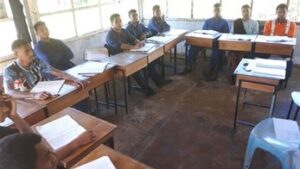
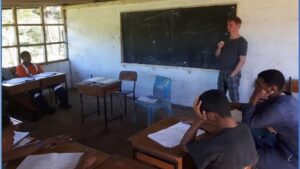
The community at the Centre work to educate, train, and empower these young men in practical work skills, including farming and animal husbandry, while also encouraging emotional and social development in terms of personal responsibility, morals and ethics, self-help, and respect for religion. The curriculum includes trade certifications in cabinet making, carpentry, welding and fabrication, motor mechanics, and farm management and animal husbandry, as well as basic accounting skills, punctuality, and time management.
Each student is asked for a contribution of $150 Fijian dollars, approximately €63, per year; however, many cannot afford to pay even this small amount. The students themselves generate income for the centre, through local carpentry and construction jobs, selling their farm produce, and running an annual bazaar where goods created during school workshops are sold. However, MSCs in the Chevalier Training Centre are struggling to do more with less daily, and they need our help.
- A donation of €330 will pay for students’ food for one week.
- €830 will be dedicated to school fees for students who are not able to pay the fees themselves.
- €1,660 will cover the costs of medical expenses, wellbeing workshops, and counselling sessions.
- €4,150 is needed to replace old and unusable mattresses, bed sheets, and curtains, while students will make new bedframes in carpentry workshops.
CAN YOU PLEASE HELP THE CHEVALIER TRAINING CENTRE?
A SAFE HAVEN AT THE CHEVALIER HOSTEL
The Chevalier Hostel was established by the Missionaries of the Sacred Heart in 1981 in Suva, in the Fiji Islands, to provide accommodation for young men who wish to continue their education, but whose families face severe financial difficulties.
The hostel caters for 14 youths at any one time, aged between 13 and 22 years. The community here also help to rehabilitate young men who have committed previous offenses and have been in trouble with the police, and who now wish to make a fresh start.
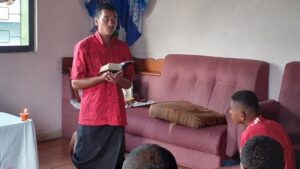
Students contribute to the running of the hostel, with regular fundraising activities. The prizes included in these fundraising endeavours include homemade marmalade and eggplant jams, pies, and cakes, and root crops from farm produce.
Every year, the Chevalier Hostel receives more and more applications from families seeking a place for their child; however, resources are becoming even more limited, and MSCs at the hostel are appealing for your help so they can continue to journey with young men who wish to improve their lives and the lives of their families.
- A donation of €290 will pay for students’ food for one month.
- €500 will provide fuel for one year.
- €415 will pay for water and electricity for the hostel for one year.
- €830 will cover the costs of medical expenses, wellbeing workshops, and counselling sessions.
PLEASE SUPPORT THE MSC COMMUNITY AT THE CHEVALIER HOSTEL
Jan 27, 2022
MSCs in Coimbatore, India, are raising funds to set up the Chevalier Centre for Change, a day-care centre for the elderly that aims to “change the lives of those who have little hope”.
MSCs in Coimbatore are responding to the needs to the local community by setting up the Chevalier Centre for Change with the aim of caring for senior citizens from disadvantaged backgrounds, who may be alone or struggling financially. The centre will allow those in need to benefit from a life with dignity, with health care, good nutrition, and access to recreational and other facilities that will ensure an enjoyable and enriched life experience in their later years.
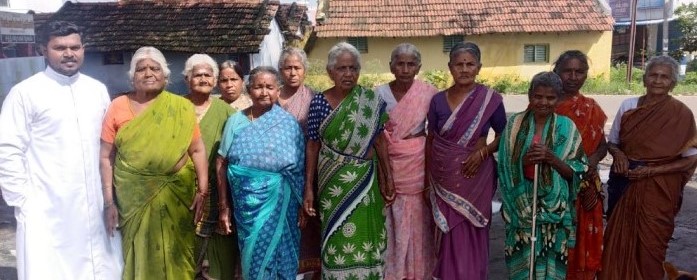
“We wish to create a world where human dignity and equality prevail”, writes Fr Darwin Thatheus MSC, Indian Union Superior, “upholding the dignity of abandoned elders in society by creating a platform for their progress and growth.”
The Chevalier Centre for Change aims to welcome between 20 and 25 elderly people four days a week, from 9.00am to 4.00pm. Senior citizens will be able to avail of a range of facilities, including a nutritious lunch and evening meal, health and medical workshops, yoga and meditation sessions, recreational facilities including movies, games, embroidery, and gardening, a worship space for prayer and peaceful reflection, a creative space with facilities for drawing, painting, and sculpture, and a reading space, with plenty of books and a peaceful environment.
MSCs in Coimbatore are raising funds to run the Chevalier Centre for Change for one year, at a total of 31,20,000 Indian Rupees – approximately €36,705, or just €7.65 per person, per day.
A donation of €125 will fund one month’s costs for an elderly person
at the Chevalier Centre for Change,
bringing warmth, light, food, health care, and company
to someone who would otherwise be hungry and alone.
PLEASE HELP US TO CARE FOR THE ELDERLY AND ALONE IN INDIA
Jan 27, 2022
Founded by MSCs in 1984, Centro Faustino Villanueva is a vocational centre dedicated to helping disadvantaged youths, located in the rural region of San Agustin, Alta Verapaz, in Guatemala.
With the motto “Open doors to education”, the centre currently works with 215 students from impoverished villages and vulnerable family groups, with a waiting list for places. Youths at the centre can study a range of three career skill sets: business administration, science, and teaching.
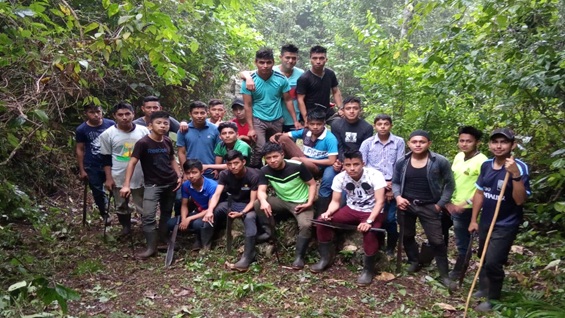
The remote setting of the school means that daily travel is extremely difficult for students of severely limited means, and so half of the students board at the school. However, the COVID pandemic has generated several social and financial crises in the region, and the centre has suffered greatly in terms of funding and resources.
The newest undertaking at the centre aims to provide students with invaluable life skills – an agricultural programme, involving tending to livestock and growing produce, which will supplement the food supply at the school, while also enabling students to take these skills back to their own localities to improve living conditions there. With suitable space and land for this agricultural endeavour, and basic equipment such as sheds and feeders for pigs and chickens, the centre is currently raising funds to set up and launch these farms as soon as possible, so the school can continue to provide opportunities for young people who otherwise have very little hope.
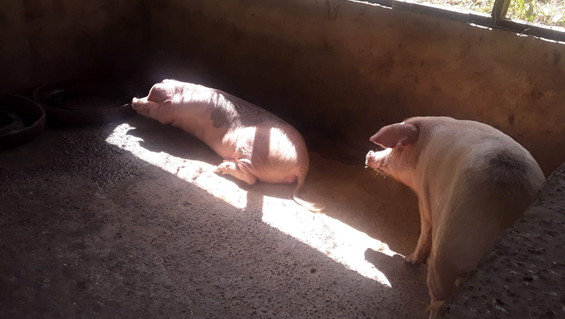
A total of €21,300 will provide the Centro Faustino Villanueva
with the livestock, vegetable seeds, and equipment they need to produce food for their community,
while bringing vital skills back to the students’ villages.
“With God’s wisdom and your support, we will continue to help our young people who yearn for a dignified and better life.”
~ Fr Jairo Uriel Sevilla Mendoza MSC,
Director of the Faustino Villanueva Centre
PLEASE HELP US TO SOW SEEDS FOR THE FUTURE IN GUATEMALA
Oct 14, 2021
In response to the continuing needs of people affected by the coronavirus pandemic in the Philippines, the community at the MSC Centre for the Poor initiative have established a new campaign which aims to help those in real and urgent need in a sustainable way.
The new campaign calls for participants to “Be a Food Security Frontliner,” encouraging supporters to respond to the needs of the poor and hungry while protecting and nurturing the land and the environment.

“People go hungry not because there is insufficient food on our farms, but because they are poor.”
“With two years of the COVID-19 pandemic and more years of uncertainty predicted to come, we have seen the gradual collapse of the Philippine health system, our domestic economy, social services, environment, and food system,” writes Fr Richie Gomez MSC, community leader at the MSC Centre for the Poor. “Soon, we will be witnessing a massive escalating hunger crisis due to food insecurity. People go hungry not because there is insufficient food on our farms, but because they are poor. Agricultural products go to those with the greatest capacity to pay, not to the most vulnerable people. As our farmers say, ‘Kami ang nag tanim, kami ang walang makain’ (‘We plant, but we have nothing to eat’).”
In addition to the COVID crisis, several other factors have severely impacted on the ability of poorer families to put food on the table. “Violent conflicts here in Mindanao, extreme weather due to climate change, biodiversity loss, and the economic downturn cause by the COVID-19 pandemic and varying degrees of community lockdowns have worsened the situation of vulnerable people,” explains Fr Richie. “In addition, water becomes increasingly scarce for smaller farmers when bigger investors use it in intensive irrigation schemes. All of these crises limit poorer people’s capacity to buy food, or to produce enough to be self-sufficient.”
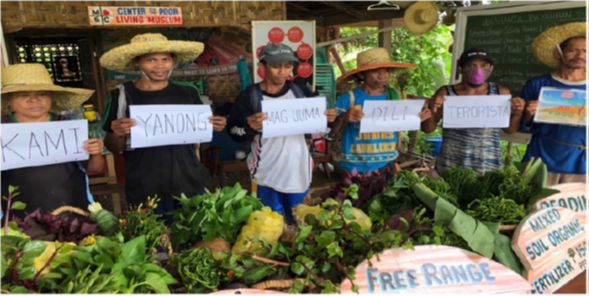
“Let us not wait for the situation to further deteriorate, when it is already too late to act.”
“Let us not wait for the situation to further deteriorate, when it is already too late to act,” Fr Richie encourages. “Let us create a food system that protects the health of both humans and the environment – providing a healthy diet for 120 million Filipinos without destroying the planet.”
The food system is one of the singular most important social and economic concerns in the Philippines, where some of the most vulnerable people, including those in farming and fishing, are ultimately the foundation. Now, the MSC Centre for the Poor Agriculture Cooperative (MSC-CEPAGCO) is focusing on building its capacity for “a more resilient, diverse model of farming and food production… based on community decisions and open-source ideas can help to develop local food systems”, eliminating dependency on larger corporate endeavours.
The Food Security Frontliner enterprise looks at developing alternative models of agricultural production and marketing, which focus on being sustainable and fair as well as generating income. This will involve “the organisation of people’s cooperatives, the use of organic agriculture and modern technology for post-harvest production, ‘the farm-to-table’ marketing strategy, and the continuing formation of the Spirituality of the Heart through the works of Justice, Peace, and Integrity of Creation”.
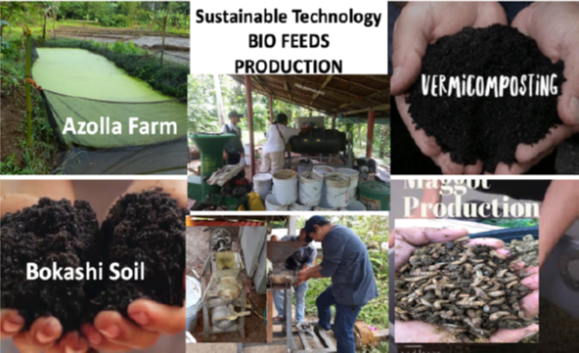
“We will be green producers, bringing our produce to green consumers.”
Pope Francis has highlighted the need for a fair-trade system in an “inclusive economy,” and this is the essential aim of the Food Security Frontliner campaign. “This means that no-one will be left out in the cycle of economy,” says Fr Richie. “We will have a daily harvest from our coop members’ farms; we will be green producers, bringing our produce to green consumers.”
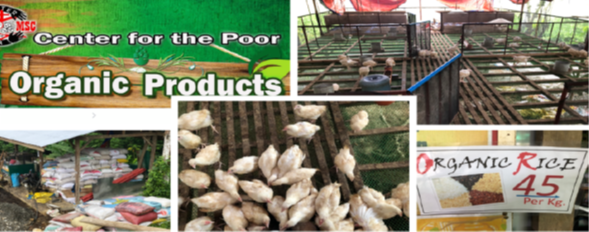
Together with disadvantaged youths on their scholarship programme, the MSC Centre for the Poor Agriculture Cooperative is implementing a programme on Environmental Management Systems, and creating income-generating projects to raise the quality of life for both rural and urban communities who use the two MSC Centre for the Poor locations, one in Butuan City and one in Del Monte Agusan del Sur.
“Our model farm in Del Monte Agusan del Sur has just been approved by the Department of Agriculture as a learning site for organic agriculture, and is soon to be a farm school for the Technical Education and Skills Development Authority,” Fr Richie says. “We want to empower small-scale farmers, the indigenous Lumad community, rebel returnees, people struggling with drugs and addiction, disadvantaged youths, and repatriated overseas Filipino workers.”
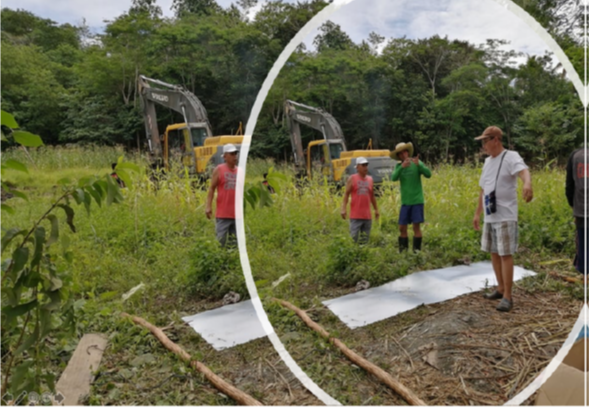
Currently, the MSC Centre for the Poor Agriculture Cooperative is working to raise funds to build three large greenhouses for organic vegetable production at the MSC Centre for the Poor Living Museum in Del Monte, Talacogon Agusan del Sur, in the Philippines, at a cost of 5,000,000 Philippine pesos, or approximately €85,500. This investment will provide the prospect of self-sufficiency and food security for generations to come.
“As an accredited cooperative organisation by the Cooperative Development Authority, our focus right now is to produce affordable, healthy food for all, producing healthy/organic farm products on a day-to-day basis.”
“This initiative is a concrete response to the needs of the poor,” concludes Fr Richie. “It is a concrete action that needs the support of our mission friends everywhere, in whatever capacity, including prayers and goodwill to promote a spirit of solidarity.”
PLEASE SUPPORT OUR MSC MINISTRY IN THE PHILIPPINES
Sep 29, 2021
Welcome to the Winter 2021 edition of the MSC Message!
• Read a special seasonal greeting from Fr Michael O’Connell MSC, Director of the MSC Missions Office.
• Join us as we congratulate Br Giacomo Gelardi on his Perpetual Profession to the Society of the Missionaries of the Sacred Heart.
• Catch up on the latest news from the mission fields, including the erection of the new MSC Province of the Pacific Islands and an update from our MSC brothers in Ecuador.
• Read more about the latest updates from our global COVID-19 relief ministry, with reports from Vietnam, Fiji, and our OLSH Sisters in the Philippines.
• Fr Alan Neville MSC writes from South Sudan, where he is currently ministering with the Loreto team in Rumbek.
• Read all about the beatification of the martyrs of El Quiché, including three MSC priests and seven lay catechists who were killed for their faith in Guatemala between 1980 and 1991.
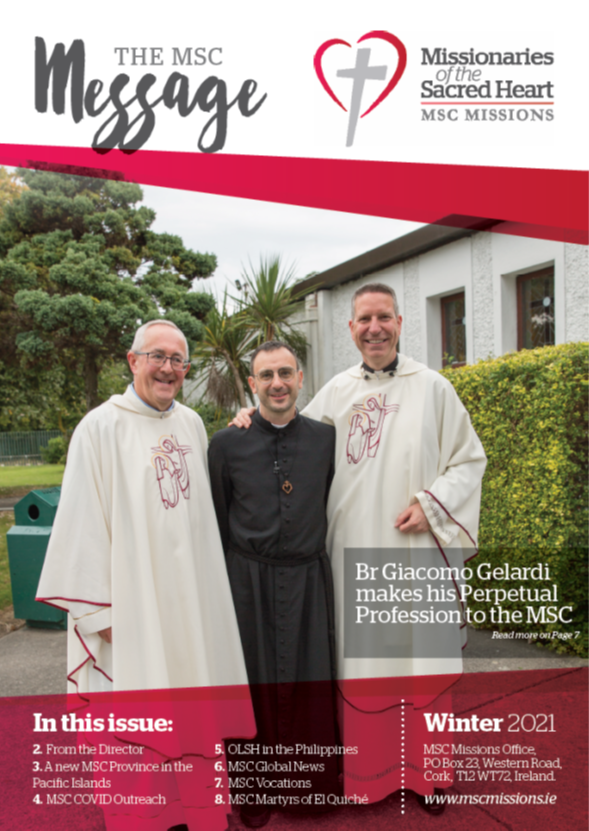
Read the MSC Message Winter 2021
*
Jul 29, 2021
Welcome to the Summer 2021 edition of the MSC Message!
This summer’s edition of the MSC Message is a slightly different one, as we share just some of the ways in which our MSCs have been working to provide COVID relief aid around the world.
• Read a special message from Fr Michael O’Connell MSC, Director of the MSC Missions Office.
• Find out more about the ways in which MSCs are protecting lives from COVID-19 in India, with reports from Fr Darwin Thatheus MSC, Regional Superior in Bangalore.
• Read about MSC COVID outreach in Brazil, from the distribution of basic care packages to the provision of safe and secure housing for families who have lost their homes.
• Learn more about MSC COVID relief aid in the Philippines, where communities are struggling desperately to fight the pandemic in the wake of appalling typhoons.
• Meet the new MSC Vocations team.
• Read a message from Bro Giacomo Gelardi MSC, who has been ministering throughout the pandemic in Killinarden, Dublin, an area already plagued by issues such as violence and drug and alcohol abuse.
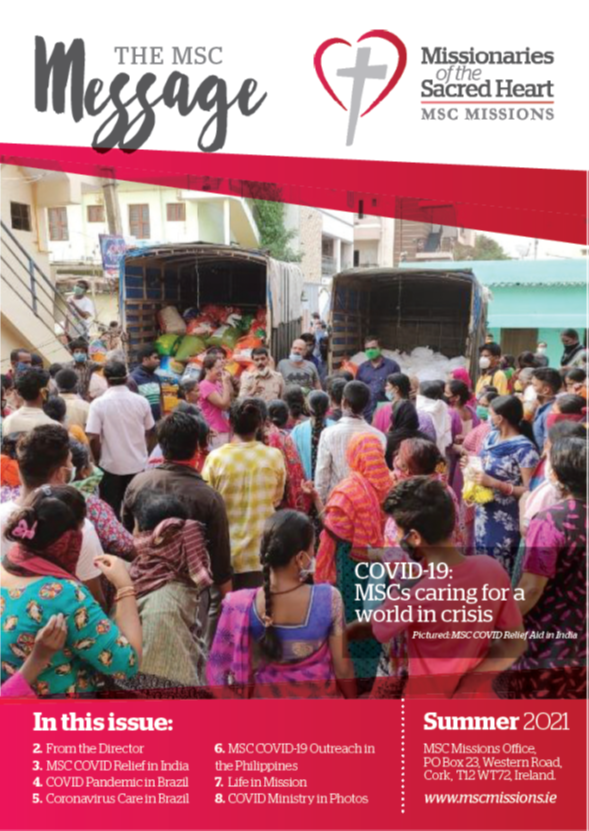
Read the MSC Message Summer 2021