Jun 1, 2017
Locals in the community of Waterval, in the Limpopo Province of South Africa, have been working together with the Missionaries of the Sacred Heart to raise funds for a new church in their parish of Louis Trichardt.
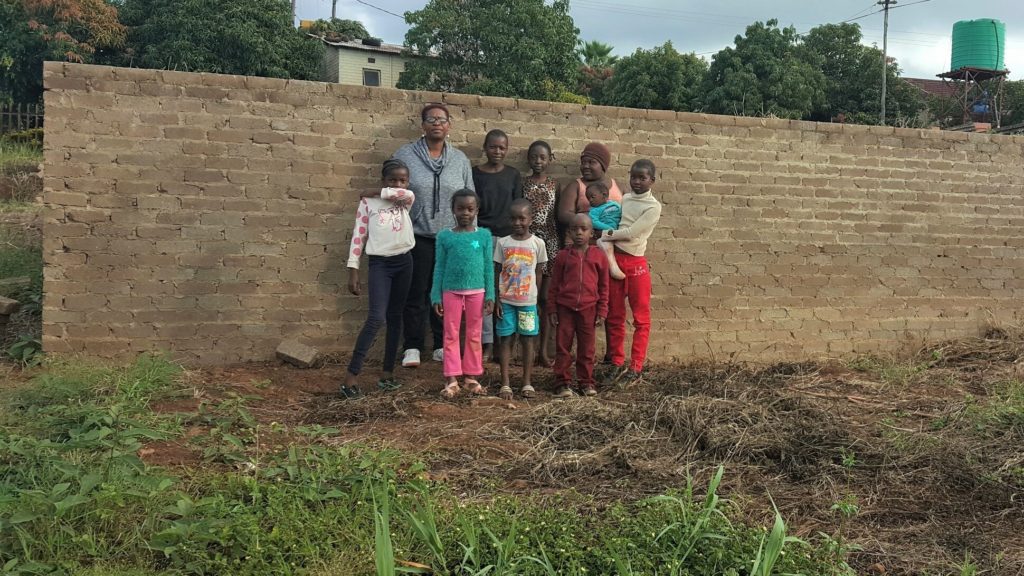
Waterval residents at the site of the new Sacred Heart Church
The Missionaries of the Sacred Heart have been working to make positive changes in the region since their arrival in 1950, with a primary focus on medical care, education, AIDS awareness and prevention, and care programmes for orphans and vulnerable youths. MSC missions in the area have made a real difference in the quality of life enjoyed by the local community, and today, our MSCs work with the people of Louis Trichardt to promote self-sufficiency with the prospect of a better and brighter future.
In Waterval, the local community began their own fundraising drive and were able to raise enough money to buy building materials and lay the foundations of their new church. The Missionaries of the Sacred Heart will provide the balance of funds needed to complete the building, and the new church will be named the Sacred Heart Church.
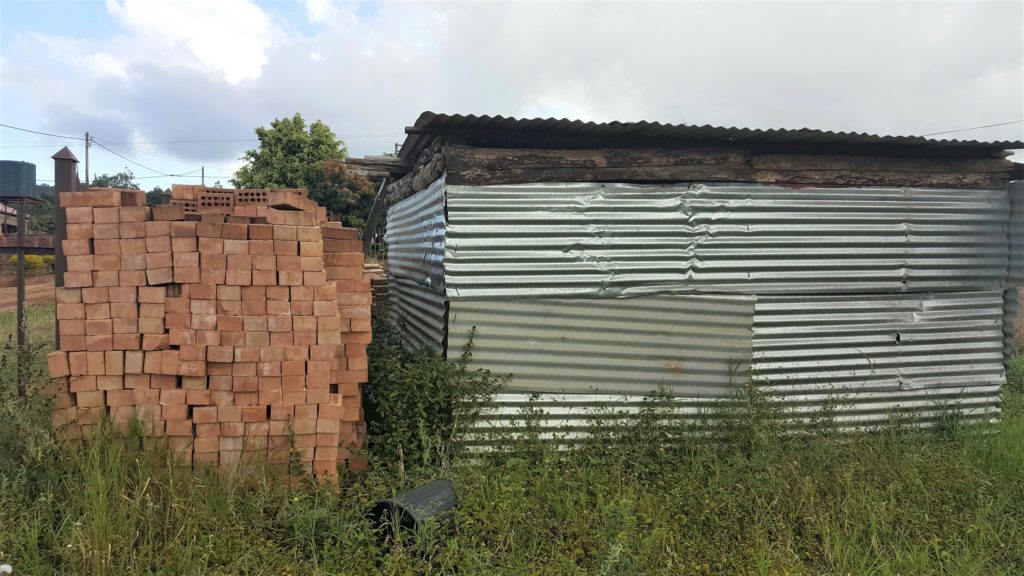
The tin shack where Waterval residents have celebrated Mass to date, alongside some of the building materials that will be used to construct the new Sacred Heart Church.
As construction begins, MSCs in the region are documenting the progress made with photographs of the build. In this small and close community, the promise of a new church is an encouraging one. Locals are extremely dedicated to their faith, and the significance of having a special place of worship is huge. To date, locals have been celebrating Mass in the tin shack pictured above; now, thanks to the combined efforts of the community and MSCs in the area, the population of Waterval can look forward to having a dedicated place of worship to call their own.
With local enthusiasm matched by the goodwill and generosity of mission friends and benefactors around the world, it’s clear to see the power that comes of unity – together, we can make a real and lasting difference.
PLEASE SUPPORT OUR MISSION PROJECTS IN SOUTH AFRICA
May 29, 2017
Sunday, 28th May 2017 marked the 51st World Communications Day. In today’s world, where communicating a message of hope and love is more important than ever throughout these turbulent times, the theme is an encouraging one:
“Fear not, for I am with you”: Communicating Hope and Trust in our Time
In his message for the 51st World Communications Day, Pope Francis said:
“Access to the media – thanks to technological progress – makes it possible for countless people to share news instantly and spread it widely. That news may be good or bad, true or false. The early Christians compared the human mind to a constantly grinding millstone; it is up to the miller to determine what it will grind: good wheat or worthless weeds. Our minds are always ‘grinding’, but it is up to us to choose what to feed them (cf. Saint John Cassian, Epistle to Leontius).
I wish to address this message to all those who, whether in their professional work or personal relationships, are like that mill, daily ‘grinding out’ information with the aim of providing rich fare for those with whom they communicate. I would like to encourage everyone to engage in constructive forms of communication that reject prejudice towards others and foster a culture of encounter, helping all of us to view the world around us with realism and trust.
I am convinced that we have to break the vicious circle of anxiety and stem the spiral of fear resulting from a constant focus on ‘bad news’ (wars, terrorism, scandals and all sorts of human failure). This has nothing to do with spreading misinformation that would ignore the tragedy of human suffering, nor is it about a naive optimism blind to the scandal of evil. Rather, I propose that all of us work at overcoming that feeling of growing discontent and resignation that can at times generate apathy, fear or the idea that evil has no limits. Moreover, in a communications industry which thinks that good news does not sell, and where the tragedy of human suffering and the mystery of evil easily turn into entertainment, there is always the temptation that our consciences can be dulled or slip into pessimism.
I would like, then, to contribute to the search for an open and creative style of communication that never seeks to glamourize evil but instead to concentrate on solutions and to inspire a positive and responsible approach on the part of its recipients. I ask everyone to offer the people of our time storylines that are at heart ‘good news’.
Good news
Life is not simply a bare succession of events, but a history, a story waiting to be told through the choice of an interpretative lens that can select and gather the most relevant data. In and of itself, reality has no one clear meaning. Everything depends on the way we look at things, on the lens we use to view them. If we change that lens, reality itself appears different. So how can we begin to ‘read’ reality through the right lens?
For us Christians, that lens can only be the good news, beginning with the Good News par excellence: ‘the Gospel of Jesus Christ, Son of God’ (Mk 1:1). With these words, Saint Mark opens his Gospel not by relating ‘good news’ about Jesus, but rather the good news that is Jesus himself. Indeed, reading the pages of his Gospel, we learn that its title corresponds to its content and, above all else, this content is the very person of Jesus.
This good news – Jesus himself – is not good because it has nothing to do with suffering, but rather because suffering itself becomes part of a bigger picture. It is seen as an integral part of Jesus’ love for the Father and for all mankind. In Christ, God has shown his solidarity with every human situation. He has told us that we are not alone, for we have a Father who is constantly mindful of his children. ‘Fear not, for I am with you’ (Is 43:5): these are the comforting words of a God who is immersed in the history of his people. In his beloved Son, this divine promise – ‘I am with you’ – embraces all our weakness, even to dying our death. In Christ, even darkness and death become a point of encounter with Light and Life. Hope is born, a hope accessible to everyone, at the very crossroads where life meets the bitterness of failure. That hope does not disappoint, because God’s love has been poured into our hearts (cf. Rom 5:5) and makes new life blossom, like a shoot that springs up from the fallen seed. Seen in this light, every new tragedy that occurs in the world’s history can also become a setting for good news, inasmuch as love can find a way to draw near and to raise up sympathetic hearts, resolute faces and hands ready to build anew.
Confidence in the seed of the Kingdom
To introduce his disciples and the crowds to this Gospel mindset and to give them the right ‘lens’ needed to see and embrace the love that dies and rises, Jesus uses parables. He frequently compares the Kingdom of God to a seed that releases its potential for life precisely when it falls to the earth and dies (cf. Mk 4:1-34). This use of images and metaphors to convey the quiet power of the Kingdom does not detract from its importance and urgency; rather, it is a merciful way of making space for the listener to freely accept and appropriate that power. It is also a most effective way to express the immense dignity of the Paschal mystery, leaving it to images, rather than concepts, to communicate the paradoxical beauty of new life in Christ. In that life, hardship and the cross do not obstruct, but bring about God’s salvation; weakness proves stronger than any human power; and failure can be the prelude to the fulfilment of all things in love. This is how hope in the Kingdom of God matures and deepens: it is ‘as if a man should scatter seed on the ground, and should sleep by night and rise by day, and the seed should sprout and grow’ (Mk 4:26-27).
The Kingdom of God is already present in our midst, like a seed that is easily overlooked, yet silently takes root. Those to whom the Holy Spirit grants keen vision can see it blossoming. They do not let themselves be robbed of the joy of the Kingdom by the weeds that spring up all about.
The horizons of the Spirit
Our hope based on the good news which is Jesus himself makes us lift up our eyes to contemplate the Lord in the liturgical celebration of the Ascension. Even though the Lord may now appear more distant, the horizons of hope expand all the more. In Christ, who brings our human nature to heaven, every man and woman can now freely ‘enter the sanctuary by the blood of Jesus, by the new and living way he opened for us through the curtain, that is, through his flesh’ (Heb 10:19-20). By ‘the power of the Holy Spirit’ we can be witnesses and ‘communicators’ of a new and redeemed humanity ‘even to the ends of the earth’ (Acts 1:7 8).
Confidence in the seed of God’s Kingdom and in the mystery of Easter should also shape the way we communicate. This confidence enables us to carry out our work – in all the different ways that communication takes place nowadays – with the conviction that it is possible to recognize and highlight the good news present in every story and in the face of each person.
Those who, in faith, entrust themselves to the guidance of the Holy Spirit come to realize how God is present and at work in every moment of our lives and history, patiently bringing to pass a history of salvation. Hope is the thread with which this sacred history is woven, and its weaver is none other than the Holy Spirit, the Comforter. Hope is the humblest of virtues, for it remains hidden in the recesses of life; yet it is like the yeast that leavens all the dough. We nurture it by reading ever anew the Gospel, ‘reprinted’ in so many editions in the lives of the saints who became icons of God’s love in this world. Today too, the Spirit continues to sow in us a desire for the Kingdom, thanks to all those who, drawing inspiration from the Good News amid the dramatic events of our time, shine like beacons in the darkness of this world, shedding light along the way and opening ever new paths of confidence and hope.”
Pope Francis
May 29, 2017
The wind beneath our wings
 I love cycling, but I hate cycling into a headwind. The wind is invisible but I feel its effects – and this makes all the difference.
In Latin, the word for wind is “spiritus”. The Spirit of the risen Jesus is invisible, but its effects can be seen. When the early Christians were trying to explain their experience of the Spirit, they used images of wind and fire – powerful images that describe a force that can move people.
It was the Spirit that moved the disciples out of the upper room and into the streets. Despite their fears and better judgement, they allowed themselves to be blown by the Spirit out into the world and to attract many to Jesus.
This same Spirit is blowing in our world today. Yet are we as Church and as individual Christians paying attention to the movements of the Spirit? Do we make our decisions in line with the Spirit’s urgings, or are we guided by intellectual caution and our fearful hearts? To return to the image of cycling, are we pedaling into the wind and getting nowhere, or are we allowing the wind to blow us in new, unexpected directions?
Pentecost is called the birthday of the Church. It is the day when the Spirit of Jesus became really alive and effective in His disciples. That is because His followers allowed the Spirit to blow them where It wanted. Our call is to let go of our fears and of old dead structures, and to allow the Spirit to surprise us and blow us in the direction that God wishes.
Fr Con O’Connell MSC
May 18, 2017
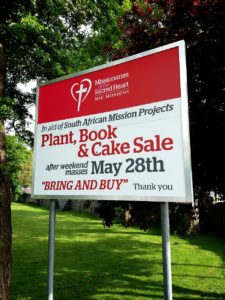 Whether you’re a gardener, a reader, or someone who simply enjoys a cup of tea and a slice of cake, don’t miss out on our upcoming MSC Plant, Book & Cake Sale in Cork!
Our Bring & Buy Sales will take place at the Sacred Heart Parish Centre on the Western Road, Cork, after 6.30pm Mass on Saturday, 27th May 2017, and after all three morning Masses (8.30am, 10.00am & 11.30am) on Sunday, 28th May 2017.
Enjoy a friendly chat, indulge in a sweet treat, and pick up a treasure or two for your bookshelf or your garden while supporting a worthy cause. All funds raised will go to the Holy Family Care Centre in South Africa, where the Sacred Heart Family are working to bring vital medical aid and educational facilities to children who are suffering as a result of HIV/AIDS and TB. Your support goes far beyond a simple gesture – together, we can make a real difference.
If you would like to donate books or plants for the sale, please bring your donation to the Sacred Heart Parish Office on the Western Road, Cork. The office is open on weekday mornings from 9.30am to 1.00pm.
Thank you very much for your support – we look forward to seeing you there!
Update: A grand total of €3,821.82 was raised at our Bring & Buy Sales. We would like to sincerely thank everybody who contributed so generously and with such goodwill.
May 17, 2017
Life under the guidance of the Holy Spirit
Gospel John 14:15-21
I shall ask the Father and he will send you another advocate.
 Writing to the Romans (Romans 8:14), Paul says: “All who are led by the Spirit of God are children of God”. The Sunday readings today stress the part played by the Holy Spirit in the lives of individual believers and of the Christian community. It is by the laying on of the hands of the Apostles that the Holy Spirit came on the believers in the Samaritan town converted by Philip. It is the Spirit of the risen Christ that gave confidence to the believers during their trials, as referred to in the letter of Peter. It is the Holy Spirit that Jesus promises to send on his followers as a second advocate, defender, and comforter.
In our own day, the Holy Spirit gives the certainty of faith in Jesus to the individual believer – belief in a world unseen. The Holy Spirit gives consolation of the soul, and the joy and peace that Jesus promised before he left. The Holy Spirit guides us as believers to live in keeping with the Gospel message, with purity of heart and with a religious attitude that takes the directions for one’s life from Heaven, from Jesus, and from the Church, rather than from a worldly secular attitude that does not believe in another world or accept direction from it.
Another thought worthy of reflection arising from today’s Gospel reading is the opposition and contest that there was, and always will be, between Jesus himself, his followers, and the other forces that the Gospel calls “the world”. Here, “the world” refers to those who were not ready to accept his person or his message, and who maintained, or will maintain, that they had been victorious over Jesus – in essence, those who believe that he and all he stood for were conquered by his death on the cross. Jesus assured his followers that the Paraclete (that advocate, the Holy Spirit) that he was to send would convince his followers (and “the world”) that the contrary was the case. They should take courage; Jesus had conquered the world. Those forces working against Jesus and his work are still active.
We need not enter in any further detail into this question here, but to recall that in this continuing contest, Jesus and his Father are also active through the Holy Spirit, the advocate and comforter. However, we may mention that an obvious example of the ongoing contest between the forces contrary to Jesus is active atheism. The “Atheist Ireland” movement is actively engaged in an effort to destroy belief in God, with special emphasis on vilifying the Catholic Church, attempting to remove any influence of Catholic (that is, Christian) religion from public life and the teaching of religion in primary schools.
Today’s Gospel and liturgical readings call for a response on at least two points:
• To recall Jesus’ promise of the Holy Spirit, which gives confidence to the conscience of each believer that he, Jesus, has “conquered the world” and all of its opposing forces, giving confidence and peace in believing.
• Not to forget the advice of St Peter in the second reading today: have a good knowledge of your religion. “Always have your answer ready for people who ask you the reason for the hope that is in you; but give it with courtesy and respect.”
Fr Martin McNamara MSC
May 15, 2017
In 2017, two of Ireland’s largest religious membership organisations, the Irish Missionary Union (IMU) and the Conference of Religious of Ireland (CORI), joined forces to create a new group, the Association of Leaders of Missionaries and Religious of Ireland (AMRI).
The IMU was originally established in 1970 for the purpose of creating a global network of missionary organisations. Currently, there are 1,500 Irish missionaries ministering in 84 developing countries around the world, with the Missionaries of the Sacred Heart working as an active part of this group.
CORI was launched in 1960, with the original title of the Conference of Major Religious Superiors of Ireland (CMRS). It currently has a combined membership of approximately 9,000 religious from 138 congregations.
This amalgamation takes place “in response to a desire to energise and support the life and ministry of the Church, both in Ireland and overseas”. In their official statement, the President of the IMU, Sr Kathleen McGarvey OLA, and the President of CORI, Fr Gregory Carroll OP, said, “We believe that a new national identity will facilitate renewal and a more effective mission outreach”.
AMRI is based in Templeogue, Dublin, at the Provincialate of the Missionaries of Africa. Fr Marc Whelan CSSp has been elected as President, with Vice-President Sr Phyllis Behan RSC. A team of members of the Executive have also been elected or co-opted, and the group are meeting regularly as the association continues its development process.
According to the official AMRI website:
“The purpose of AMRI will be to represent and promote active collaboration between
Religious Institutes, Societies of Apostolic Life and Missionary Organisations,
so as to respond to existing and emerging realities both in Ireland and overseas
by supporting and energising the life and ministries of their members
and of the wider Church with a renewed sense of hope and relevance.
Among other objectives, it will seek to develop and promote religious, apostolic and missionary life
as a vibrant, prophetic, organic and integral feature of the life of the church.”
We wish all at AMRI every blessing as they undertake this new venture, moving towards an exciting future for missionary outreach at home and abroad.