Dec 1, 2021
Please note that the MSC Missions Office will be closed over the Christmas period,
from 4.00pm on December 23rd to 9.00am on January 4th.
With warm wishes to our mission friends everywhere for a happy, healthy, and safe Christmas season.

Dear Friends,
Christmas greetings to you and your loved ones! While we have all endured another year of uncertainty, it is a great blessing to be able to look to the festive season and the coming year with hopeful hearts.
This will be a particularly special Christmas for me, as it will be the last that I celebrate as Director of the MSC Missions Office. As such, this is the last time that I will have the opportunity to send you my Christmas wishes as Director, ahead of Fr John Fitzgerald MSC taking over the role in the new year. The ending of one year and the beginning of the next strikes me as an especially fitting time for change, and it is with fondest regards that I thank you for your friendship throughout the years. It has been a gift beyond measure, and I’m sure that you will welcome Fr John with the same generosity and kindness that I have been so privileged to receive in my time as Director.
Over the past two years, our ongoing mission projects have come under tremendous strain as a result of the challenges introduced by the pandemic, and our missionaries are working tirelessly to combat the effects of COVID-19 in areas where even basic resources like clean water are sorely lacking, while also maintaining ongoing ministry in the provision of education, healthcare, and community support in vulnerable and disadvantaged regions. With each year that passes, we are trying to do more with less, and the past two years have proved particularly challenging, in ways that none of us could have imagined. Thanks to you, our dear mission friends, we can continue to face those challenges head-on; your support provides a real and vital lifeline to countless families who would otherwise be without hope. Together, we are a powerful and wonderful force, a force that can continue to combat the fear, sorrow, and anxiety that plagues our world in current times.
Christmas can be a difficult time for many, and that has, of course, been exacerbated by the pandemic in its second year. Whether you are fortunate enough to be surrounded by the warmth of family this festive season, or whether you may be struggling with your own personal challenges, please know that you are in my prayers this Christmas, and in the prayers of our MSCs everywhere.
As we approach a new year and a new chapter for the MSC Missions Office, my prayers are with you and those you hold dear. May the light of the Lord’s love shine in your heart and in your home this Christmas season, and guide your path throughout the new year and always. May you be blessed with the spirit of Advent, and may God grant you and your loved ones a peaceful, prayerful Christmas and a safe, happy, and healthy New Year.
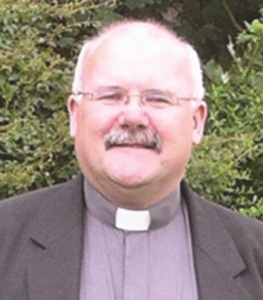 Wishing you and yours a happy and holy Christmas,

Fr Michael O’Connell MSC
Please click here to read letters from Fr Michael, Fr John, and Irish Provincial Superior Fr Carl Tranter MSC, as we begin a new chapter for the MSC Missions Office in 2022.
Nov 24, 2021
‘Tis the season of goodwill to all, and of course, the season of giving – and there’s no better way to celebrate than with a gift that gives back to the people who need it most.
Our wonderful selection of Christmas keepsakes make the perfect gift for someone special – and by choosing one of our festive gifts, you’re supporting the life-saving work our missionaries are doing across the world. Over the past two years, our ongoing mission projects have come under tremendous strain as a result of the challenges introduced by the pandemic, and our missionaries are working tirelessly to combat the effects of COVID-19 in areas where even basic resources like clean water are sorely lacking, while also maintaining ongoing ministry in the provision of education, healthcare, and community support in vulnerable and disadvantaged regions. By choosing to send one of our Christmas gifts this year, you’re giving families and communities in need a real reason to celebrate this festive season.
Explore our range of festive cards and gifts and bring Christmas joy to your home…
Delicately crafted angel ornaments inscribed with messages of peace and inspiration will bring a seasonal warmth to any Christmas display.
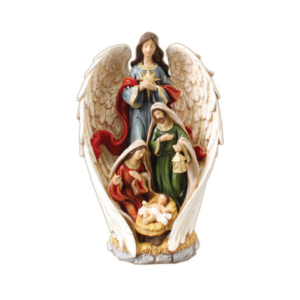
A beautiful nativity scene captures the essence of the Christmas season, with the Holy Family wrapped in the peace and goodwill of angelic protection.
A selection of battery-operated candles offer everything from prayers to the Holy Family to blessings for your home, while the LED flickering flame means that you can enjoy the warmth and glow of candlelight in safety, year after year.
You can also find the perfect Christmas Mass Bouquet Card to send seasonal greetings to loved ones at home and abroad, with inclusion in this year’s Christmas Mass Triduum, which will take place from December 20th to 22nd at the Sacred Heart Church on the Western Road, Cork.
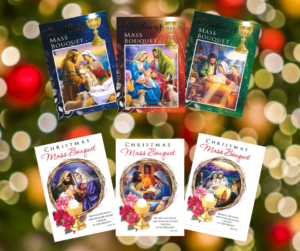
Whether you’re choosing a festive ornament for your own home, or sending a seasonal surprise to brighten a loved one’s day, you’ll find the perfect Christmas keepsake – and a gift that keeps on giving – in our seasonal range.
This Christmas, please consider giving a gift that makes a difference. Your goodwill is a gesture that reaches far beyond the holiday season, and gives real and lasting hope to those in need.
BROWSE OUR CHRISTMAS GIFT RANGE
*
Nov 18, 2021
In October, the MSC Indonesian Province celebrated its 50th anniversary. Founded on October 6th 1971 by the MSC General Conference in Rome, the Indonesian Province has since gone from strength to strength, working to provide vulnerable communities with everything from opportunities in education to emergency aid in the face of natural disasters.
As the Indonesian Province continues to grow and to serve in the love of the Lord, we wish our MSC brothers there every blessing, and heartfelt congratulations on this very special anniversary. May the Sacred Heart of Jesus be everywhere loved!
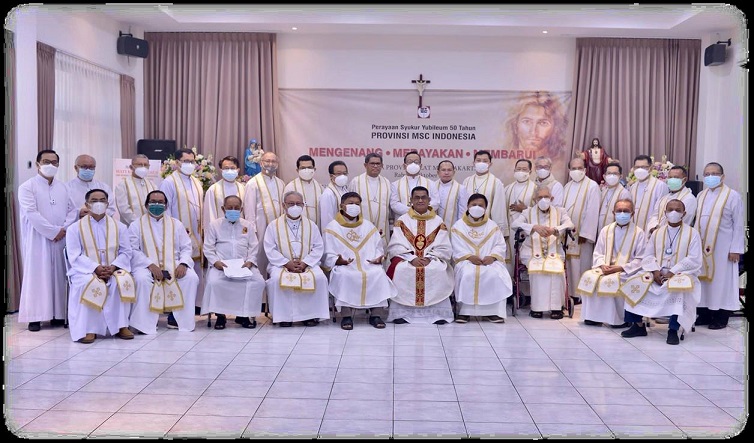
Below, you can read a letter from Yoseph Harbelubun MSC, originally published on the Missionaries of the Sacred Heart Australia website in celebration of the 50th anniversary of the MSC Province of Indonesia.
“In this part of the world, we have our largest province, Indonesia. We have PNG, Australia, Pacific Islands.
On October 6th, 2021, the MSC Indonesian Province celebrated the 50th anniversary of the founding of the province. Before it became an autonomous province, MSC Indonesia was under the Dutch MSC Province. However, after going through various preparations, the MSC General Conference in Rome in October 6th, 1971 erected the MSC Indonesian Province and appointed Fr. P.S. Hardjasoemarta to be the first Provincial Superior.
The Acts of the MSC General Conference, held in Rome from 5 to 15 October 1971, states: ‘On October 6th, 1971, the General Conference erected the MSC Province of Indonesia. Consequently, Fr Hardjasoemarta is the first provincial superior of the new province.’ The preceding text says: ‘Indonesia has been a Vice-Province, or Provincial Administration since 1961. The special Provincial Chapter held in June 1971 judged that the time had come to ask for the erection of the Indonesian Province. The number of native-born Indonesians has been steadily increasing: 32 priests, 21 brothers, 20 students. Furthermore, there are still many foreign-born MSC working in Indonesia (136). These are free to decide whether they become members of the new Province or remain members of their Province of origin’ (Analecta MSC, N. IV, Anno LXIX – 1971, p. 322). Since then, MSC Indonesia has been independent, managing its life and ministry independently, apart from the Dutch Province.
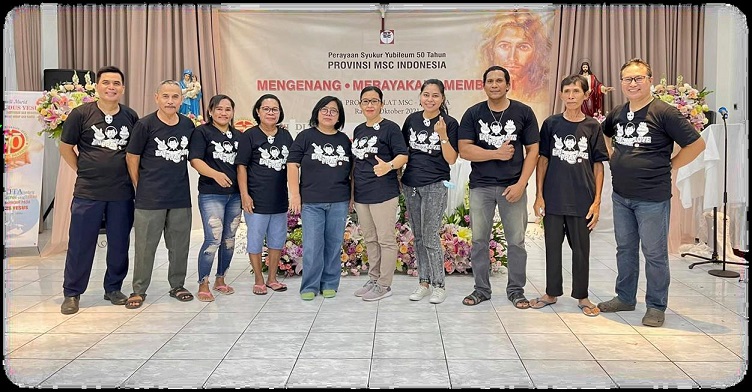
‘Becoming Disciple of the Sacred Heart of Jesus who Remembers, Celebrates, and Renews His Being and Doing.’
Many events have shaped the MSC Indonesian Province as it is today and towards the future. Therefore, celebrating the 50th foundation anniversary is a historical moment that deserves to be remembered and celebrated – remembering the great works of God experienced in the history of God’s People, especially the journey of the MSC Congregation in Indonesia. This 50th foundation anniversary is not only an opportunity for Indonesian MSC to remember and celebrate, but also to renew their being and actions. Therefore, the theme is ‘Becoming Disciple of the Sacred Heart of Jesus who Remembers, Celebrates, and Renews His Being and Doing.’
In order to make this 50th foundation anniversary meaningful, the Provincial Superior with his Council launched the Jubilee Year in October 6th, 2020. The opening ceremony of the 50th Jubilee began with the celebration of the Eucharist, followed by a short ceremony to mark the start of the Jubilee Year. The launching ceremony took place in the Chapel of the Mother House in Jakarta and was broadcast virtually. In addition, following the launching ceremony, members of the province also marked the opening of the Jubilee Year in every District and Local Communities with different planned activities.
The Provincial Superior with his Council formed a committee in the province, headed by Fr. Florianus Miranta MSC (the vicar) to coordinate various activities to celebrate the 50th Anniversary of the MSC Indonesian Province.
The committee worked to construct the history of the MSC Indonesian Province; to organize materials for reflection on the theme of the jubilee year; to construct a survey questionnaire and to present the results on the ‘being and doing’; to compose prayers; to prepare liturgies and to deepen understanding of the special prayers of the MSC; to prepare events to celebrate the 50th anniversary of the province ; to produce publications and documentation; to hold social services and to raise funds to support activities of the 50th anniversary of the MSC Indonesia Province. Apart from the Province Committee, local committees were also formed in each District and Local Community.
The journey and growth of the MSC Indonesian Province cannot be separated from cooperation and partnership with the dioceses, institutions, diocesan priests, religious congregations, lay people and other partners. Therefore, this 50th Jubilee celebration is not merely a celebration of MSC but is expected to also involve our partners and all the faithful people. However, due to the Coronavirus pandemic situation, many activities were carried out internally, such as the preparation and publication of a book series on the history of the MSC Indonesian Province; prayers and novenas for the Jubilee Year; webinars on special prayers of MSC; recollection and reflections to deepen the theme of the Jubilee Year in the District and Local Communities; webinars on the theme ‘communio, missio, leadership and the future’. The committee has been preparing a memorial book and a ceremony for the 50th Anniversary of the Province. In addition to the activities coordinated by the Committee in the Province, each District and Local Community also carried out various activities to celebrate the Jubilee Year according to their context.
Thus, as a Province that is growing and developing, and remembering the historical milestones that have formed the province, together with the Blessed Virgin Mary, Our Lady of the Sacred Heart, all members of the MSC Indonesian Province exclaim: ‘My soul magnifies the Lord……. For the Mighty One has done great things for us’ (Luke 1:49). Let us gratefully remember this historical moment: ‘May the Sacred Heart of Jesus be everywhere loved!’ (Ametur ubique terrarum Cor Jesu Sacratissimum).”
Yoseph Harbelubun MSC
(Province of Indonesia)
PLEASE SUPPORT OUR MSC MISSIONS IN INDONESIA
Images via the Missionaries of the Sacred Heart Australia website.
*
Nov 11, 2021
As it is written in Ecclesiastes,
“For everything there is a season, and a time for every matter under heaven” (3:1-2)
– and with the dawn of the new year comes a new season for the MSC Missions Office.
The Irish Provincial Leadership Team has announced that Fr Michael O’Connell MSC will be stepping down from the position of Director of the MSC Missions Office in the new year, with Fr John Fitzgerald MSC taking over the role in early 2022.
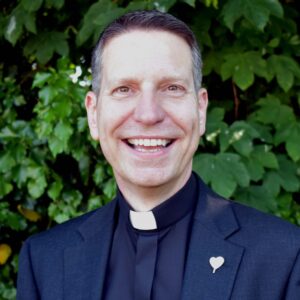
Fr Carl Tranter MSC
“I am writing today to share the news that, after 22 years as Director of the MSC Missions Office, Fr Michael O’Connell MSC will be standing down from this post in the new year,” writes Irish Provincial Superior Fr Carl Tranter MSC.
“I am glad to be able to tell you that Fr John Fitzgerald MSC will be stepping into the role of Director,” Fr Carl continues. “Having worked in close proximity with the Missions Office for many years now, I know that Fr John will bring with him many gifts and will be a wonderful addition to the team there.”
As we look ahead to the new year, Fr John is already working closely with Fr Michael and the team at the MSC Missions Office in order to make sure that this new chapter will herald a bright new era for our missionary work in the Irish Province and beyond.
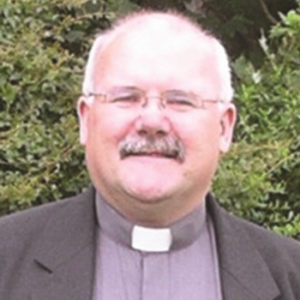
Fr Michael O’Connell MSC
“Thank you for your prayers, for your friendship, for your kindness, for your generosity, and for your continued support of our missionaries as they carry out their great work across the world,” writes Fr Michael, in a message to our mission friends. “Your support has been a real gift to me, and as we navigate our new paths, I know that your kindness and generosity of spirit will extend to Fr John in my stead. As I prepare to take my leave, rest assured that you will remain in my heart and my prayers as Fr John and I work together to make sure that this new season will be a peaceful, prayerful, and positive one for all.”
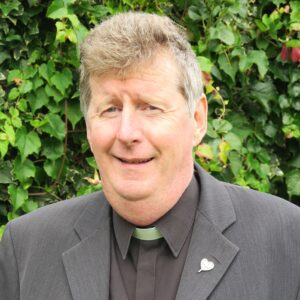
Fr John Fitzgerald MSC
Fr John echoes these sentiments as he says, “At the moment, Fr Michael is journeying with me, and thanks to his dedication, he leaves a rich legacy; our missionary work continues, however, and I have every confidence in your support for the future. You are a marvellous community of mission friends and your generosity is a true reflection of the love of the Heart of Christ. I too, like Fr Michael, pray that this new season will be peaceful, prayerful, and positive for all.”
With heartfelt thanks to Fr Michael for his tremendous contribution over the past two decades,
we also extend a warm welcome to Fr John as he takes up his new role.
United in faith, we will continue to work together to shine the light of God’s love
where it is needed most.
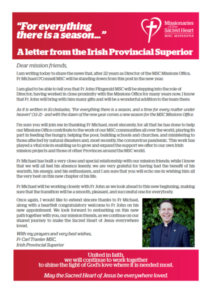
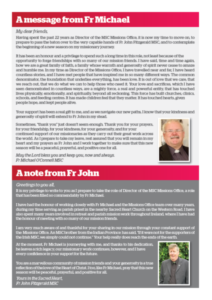
Please click to read the full letters from Fr Carl, Fr Michael, and Fr John.
Nov 11, 2021
In November, we remember, as we pray especially for loved ones who have gone before us. This year, we invite you once again to take part in a special live streaming of our annual Light Up a Memory Mass, which will be celebrated on Saturday, November 27th by main celebrant Fr John Fitzgerald MSC. The candlelight memorial service will take place at 6.30pm and will be streamed live from the Sacred Heart Church on the Western Road, Cork.
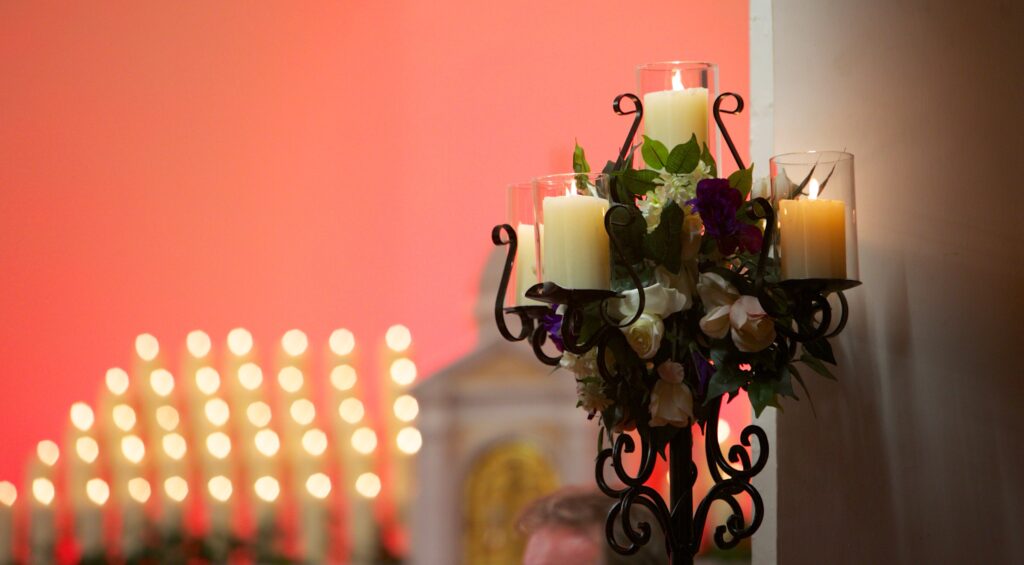
Traditionally, the Month of the Holy Souls is a time to reflect and pray for friends and family who have gone to their eternal rest in the Lord’s love. Sadly, loss and grief have been companions to many during the coronavirus pandemic, and this November, we remember specially those who are no longer with us.
Each year, the Missionaries of the Sacred Heart invite mission friends to send the names of their dearly departed for remembrance, and the list is kept on the altar throughout the month as we pray for their perpetual peace. Marking the end of the month of remembrance, the Light Up a Memory Mass lights up the winter darkness in honour of our faithful departed.
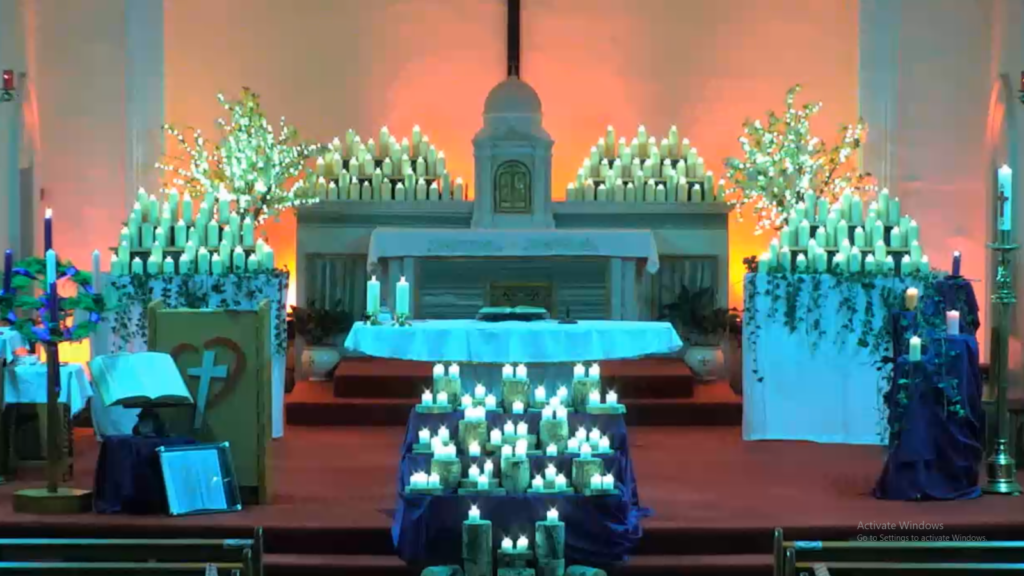
Since the first MSC Light Up a Memory Mass took place in 2014, this has become a much-loved tradition to close the Month of the Holy Souls. “Bereavement touches us all, and our Light Up a Memory Mass is a very special way for families to remember together,” says MSC Missions Office Director Fr Michael O’Connell, who will also be participating in this year’s ceremony. “It is a welcome moment to pause, to reflect, and to honour fond memories, with every candle a tribute to beloved friends and relatives.”
All are welcome to join us in reflection on this special night, and to submit the names of departed family, friends, and loved ones for remembrance. We would greatly appreciate your support for our ongoing mission projects, and in gratitude for your contribution, we will be glad to remember your intentions at our annual Mass. You can then submit the names of your departed loved ones online, and our MSC priests will remember them specially during our Light Up a Memory Mass.
While the pandemic has meant that the way we pray together has had to change, we remain ever united in spirit and in faith. Please join us for an evening of reflection and remembrance in honour of the loved ones who are always in our thoughts.
Find out more about our annual MSC Light Up a Memory Mass.
Please click here to watch the Light Up a Memory Mass, and all November Masses for the Holy Souls, on our live stream.
Nov 11, 2021
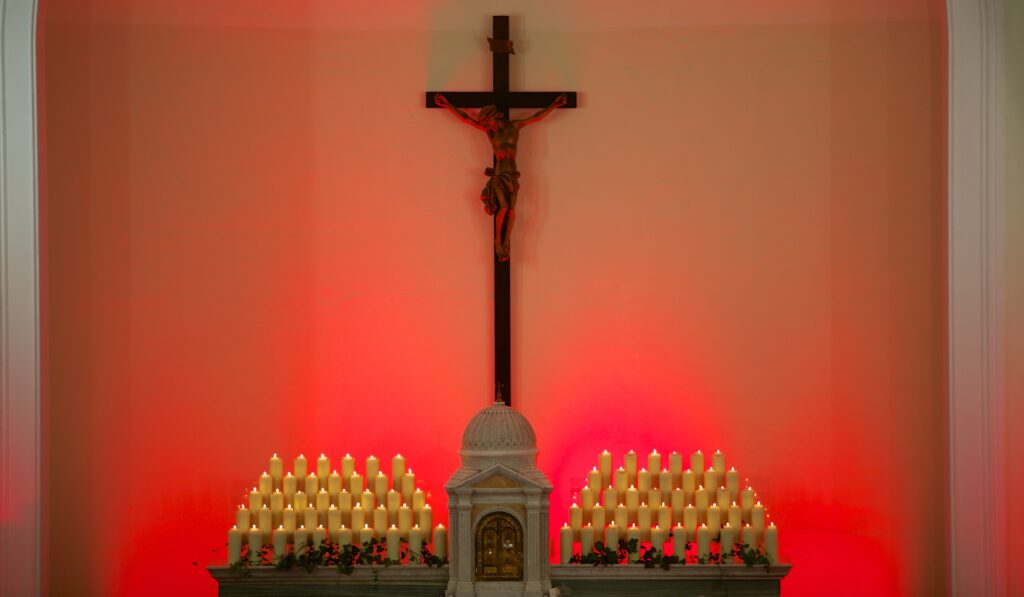
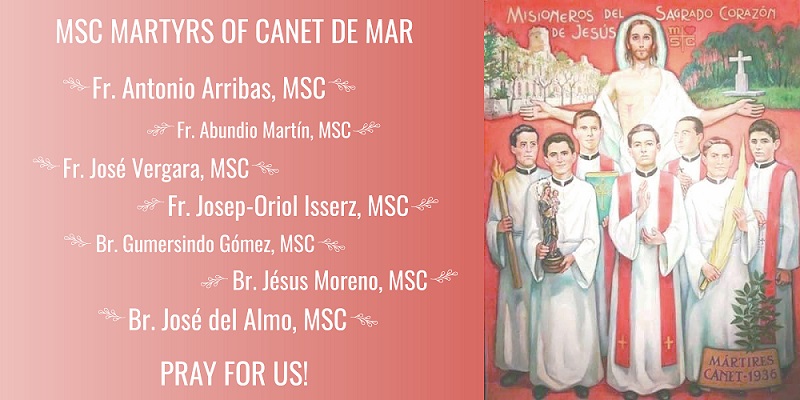
The beginning of November marked the feast day of the seven MSC martyrs of Canet de Mar, who were the first members of the MSC congregation to be declared blessed, in May 2017.
November 6th is the feast day of the seven martyrs, namely Fr Antonio Arribas, Fr Abundio Martín, Fr José Vergara, Fr Josep-Oriol Issern, Br Gumersindo Gómez, Br Jésus Moreno, and Br José del Almo. These seven MSCs lived and worked in the Pequeña Obra in Barcelona in the 1930s; this was a minor seminary in Canet de Mar, where they worked with 65 young people on their spiritual journey to religious life and priesthood. The religious persecution brought about in the course of the Spanish Civil War saw these seven men brought to a cruel and brutal death, murdered for their faith and their devotion to the Lord’s work.
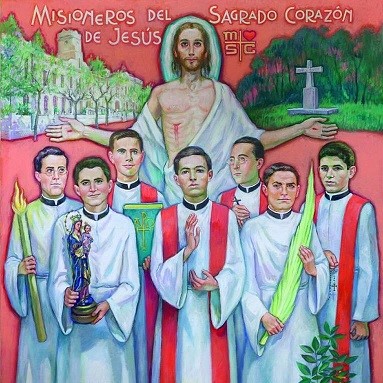
The Spanish Civil War began on July 18th 1936, and just three days later, on July 21st, the parish church of Canet de Mar was set on fire and burned to the ground. On the afternoon of the same day, an armed group approached the seminary and demanded that the community there leave the premises with immediate effect, under the orders of the People’s Committee. Following the command, the community were brought to a park nearby, located near the Shrine of Mercy, and they were kept under close surveillance there for a fortnight.
On August 3rd, the seminary director received a warning from a member of the People’s Committee, forewarning him of the danger to come. The Committee were planning a mass shooting, with the exception of children and elderly priests. In the face of immediate and severe danger, the religious leaders had to leave the seminarians, forming two groups for escape, one of four and the other of seven.
Fleeing under the cover of darkness, the group of seven MSCs travelled towards the French border in great fear and peril. While they were fortunate to receive help from several farmsteads, they travelled in hiding, through unfamiliar territory, without a supply of food or water and through all weathers.
Eight weeks later, on September 28th, the group arrived at the farmhouse of Mont-Ros at nightfall. One of the group approached the house to ask for directions, looking for information about the correct road to take to the French border. Following the instructions they had been given, they had travelled just over a kilometre before they were apprehended by a group of members of the People’s Committee. Their whereabouts had been betrayed, and they were immediately captured and taken to Committee headquarters in a schoolhouse.
At around 10.00pm that night, the MSC group were handed over to the Committee of Sant Joan les Fonts, Girona. A woman in a neighbouring property saw the MSCs as they awaited their fate, pacing in the hallway and praying the Rosary. The following afternoon, the MSCs were removed from the schoolhouse before a watching crowd, bound two by two, with the remaining individual walking alone with his hands tied behind his back. They were silent, and largely appeared to be at peace, although one of the younger MSCs was in tears. The waiting crowd also remained silent in the face of such dignity, though one of the Committee members railed against the Pope, the church, and the clergy.
The prisoners were transferred onto a bus, which came to a halt on the banks of the River Ter. Several men working in the nearby fields saw the bus stop, and four men, bound in pairs, were removed and brought towards a nearby slope. These witnesses were able to hear loud arguing, followed by gunshots, and saw the four bodies fall at the same time. The final three men were then removed from the bus, to suffer the same fate.
“They clung so closely to Christ that they died carrying in their hands crucifixes, bibles, medals, bearing witness to their faith,” reflects the Ametur MSC Facebook page.
Men from the nearby town of Serinyà, known as good Christians, were compelled by the People’s Committee to carry the seven bodies to the town cemetery, where the MSC martyrs were buried in two tombs. They remained at rest here until March 1940, when their bodies were exhumed and brought to the cemetery of Canet de Mar, located close to the MSC community. Their remains now rest in one of the chapels of the Shrine to Our Lady of the Sacred Heart in Barcelona, following their beatification in 2017.
In the course of their lives, and through their dignity and devotion in death, the MSC martyrs of Canet de Mar lived and died in the full and true sense of the motto of the Society of the Missionaries of the Sacred Heart: “May the Sacred Heart of Jesus be everywhere loved”.
Images via the Missionaries of the Sacred Heart Australia website and the Ametur MSC Facebook page.
*